
Search
Did you mean: Cronus?
Remove Ads
Advertisement
Search Results
Image
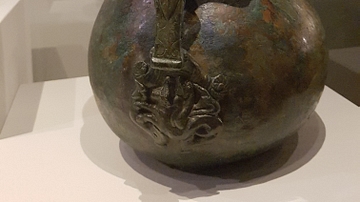
Bronze Pitcher From Pompeii
A bronze pitcher with Nereid (sea nymph). 1st century CE. Soprintendenza Archeologica di Pompei, (photo taken at the National Maritime Museum, Sydney Australia) Utensils for serving food were another way of showing your wealth. This bronze...
Image
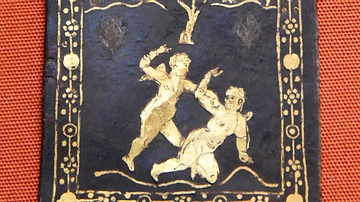
Bronze Plaque Showing Cupids Wrestling & Boxing
The background metal is bronze containing traces of a gold and silver, and its surface has been deliberately darkened, perhaps by organic acids. It may be an example of what Pliny calls "Corinthian bronze", which was said to contain gold...

Definition
Urartu Civilization
Urartu, also known as the Kingdom of Urartu or the Kingdom of Van, was a civilization which developed in the Bronze and Iron Age of ancient Armenia, eastern Turkey, and northwestern Iran from the 9th century BCE. Controlling territories through...
Definition
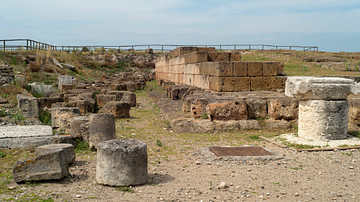
Vulci
Vulci (Velch) was an Etruscan city located 12 km from the western coast of central Italy by the banks of the Fiora River. Flourishing as a trading port between the 6th and 4th century BCE, it was an important member of the Etruscan League...

Image
Spartan Woman Bronze Statue
A bronze statue, likely of a Spartan woman. c. 500 BCE. (British Museum, London)

Image
Gilded Bronze Hercules
A colossal gilded bronze statue of Hercules, 2.41 m high. 2nd century BCE. (Capitoline Museums, Rome)

Image
Alexander the Great, Bronze Head
Head of Alexander the Great from a smaller than life-size statue, goldleaf on bronze, 2nd century CE. (Palazzo Massimo, Rome).

Image
Head of Zeus, Artemesium Bronze
A detail of the Artemesium bronze believed to represent Zeus (or Poseidon), 460 BCE. (National Archaeological Museum, Athens).

Image
Greek Bronze Ballot Disks
Bronze ballot disks used in Greek courts to vote guilty (a hole in the centre) or innocent (a solid centre). c. 300 BCE. (Agora Museum, Athens)

Image
Bronze Head of Medusa
The bronze head of Medusa is a decorative element from one of the Nemi Ships built by Caligula around 37-41 CE. It is now in the Palazzo Massimo alle Terme in Rome.
