
Search
Search Results
Image
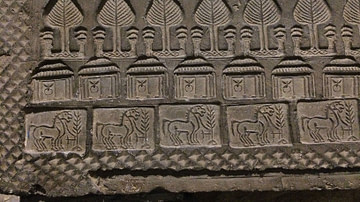
Ancient Chinese Brick from Tomb Doorway
This is an ancient Chinese brick from a tomb doorway, which was created during the Han Dynasty (206 BCE-220 CE) and made from clay. This brick shows trees, tomb doorways, and tethered horses. (Victoria & Albert Museum, London)

Image
Stamped Mud-Brick from Babylon
A close-up view of a partially broken stamped mud-brick. I found the brick on the earth! Babylon, modern-day Bebel Governorate, Iraq.
Image
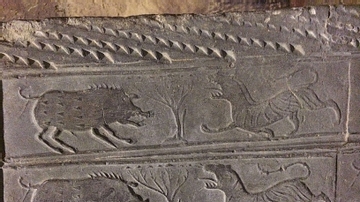
Ancient Chinese Brick
This is an ancient Chinese brick from a tomb doorway, which was created during the Han Dynasty (206 BCE-220 CE) and made from clay. This brick depicts dueling boars and tigers. (Victoria & Albert Museum, London)

Image
Chalcolithic Stamp Seals
This is a stone gable-shaped seal. It is carved with a procession of three horned animals, probably gazelles. From Central Turkey or Northern Syria. Late Chalcolithic (Copper) Age, 4000-3000 BCE. (The British Museum, London).

Definition
Boston Tea Party
The Boston Tea Party was an act of political protest carried out by American colonists on 16 December 1773, in Boston, Massachusetts. Disguised as Mohawk Native Americans, the colonists dumped 342 crates of tea into Boston Harbor to protest...

Definition
Patrick Henry
Patrick Henry (1736-1799) was a Virginian lawyer and politician who played a vital role in the American Revolution (c. 1765-1789). Known for his brilliant oration, including the famous Give Me Liberty or Give Me Death speech, Henry served...
Image
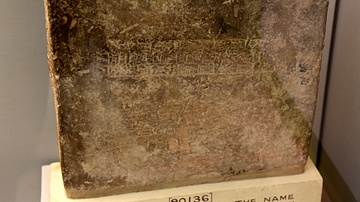
Brick Stamped with the Name of Nebuchadnezzar II
King Nebuchadnezzar II's building program at Babylon used around 15,000,000 baked bricks. Thousands bore his name and titles stamped into the clay: "Nebuchadnezzar...the eldest son of Nabopolassar, King of Babylon, am I". On this brick, a...
Image
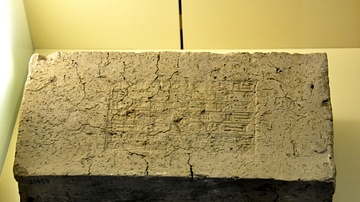
A Stamped Brick of Nebuchadnezzar II
A hollow brick with a stamped inscription of the Neo-Babylonian king Nebuchadnezzar II. From Babylon (modern Babel Governorate), Mesopotamia, Iraq. 604-562 BCE. (The Pergamon Museum, Berlin).
Image
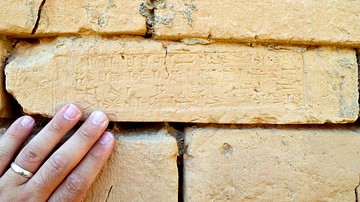
Inscribed Brick at the Processional Way of Babylon
This is an original brick in of the walls of the processional way (or street) at the ancient city of Babylon, in modern-day Iraq. The name of the builder (the neo-Babylonian king Nebuchadnezzar II) appears in the cuneiform inscription. Neo-Babylonian...
Image
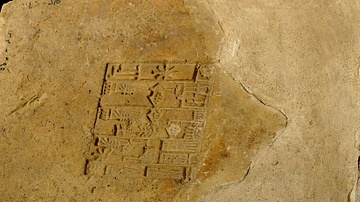
Stamped Brick with the Name of Ur-Nammu
A brick stamped with the name of Ur-Nammu, king of Ur. Neo-Sumerian era, Ur III dynasty, 2111-2003 BCE. From Ur, southern Mesopotamia, Iraq. (The Sulaimaniya Museum, Iraq).
