
Search
Did you mean: Merlin?
Remove Ads
Advertisement
Search Results
Image
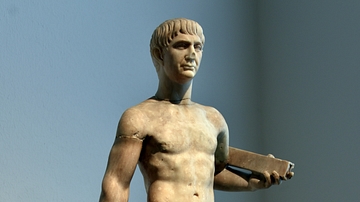
Statuette of Trajan
The head and torso of this statuette did not originally go together. The head is a portrait of the Roman Emperor Trajan (r. 98-117 CE). Records of the sculpture, first presumed to be a gladiator, can be traced back to the Venetian...
Image
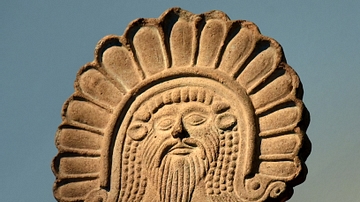
Antefix Depicting Achelous
This leaf wreath antefix shows the head of Achelous. Achelous was the god of water and rivers of the whole world. Clay. From Curti, near Capua, Italy. Etruscan, 480-460 BCE. It is on display at the Altes Museum in Berlin...

Image
Statue of a Girl Playing Knucklebones
The motif of the seated young girl dates back to a late Hellenistic model, which in the Roman version, was supplemented by the game gesture. The knucklebones (astragalus) game are often also depicted on funerary...

Image
Bowl with a Figure of Cybele
This bowl is part of the so-called "Hildesheim Silver Treasure" and depicts a medallion of Cybele. This relief probably had been originally attached to a piece of decorative armor as a military medal. The Hildesheim...
Image
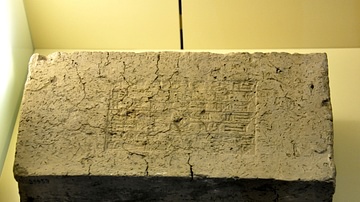
A Stamped Brick of Nebuchadnezzar II
A hollow brick with a stamped inscription of the Neo-Babylonian king Nebuchadnezzar II. From Babylon (modern Babel Governorate), Mesopotamia, Iraq. 604-562 BCE. (The Pergamon Museum, Berlin).
Image
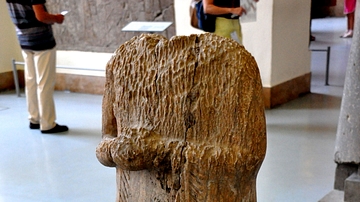
Statue of a ruler of Ashur
This alabaster statue depicts a man who wears a fringed robe. It probably came from an Ishtar temple. The statue likely represents a local ruler of the city of Ashur; his name was Zariqum. This ruler was loyal to Amar-Sin...
Image
Stela of Queen Sammu-Ramat
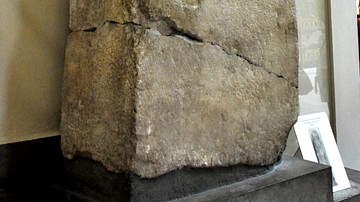
Stela of Queen Sammu-Ramat from Assur (Ashur), northern Mesopotamia, modern-day Iraq. Neo-Assyrian Empire, c. 809 BCE. The cuneiform inscriptions on the upper part of the stela say that Sammu-ramat (or Shammuramat) is...

Image
Glazed-bricks of the processional street
A close-up view of some glazed-bricks of the side walls of the processional street at Babylon. The street and its Ishtar Gate were built by King Nebuchadnezzar II. From Babylon, Mesopotamia, Iraq. Neo-Babylonian...
Image
Selene
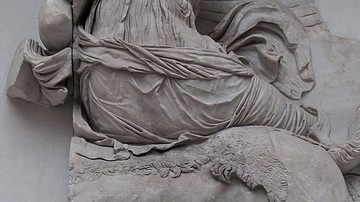
The moon goddess Selene is riding on her mule over one of the giants. Detail from the Pergamon Altar's frieze (The frieze depicts the Gigantomachy); built in 2nd century BCE; Today in the Pergamon Museum in Berlin.

Image
Ishtar Standing on a Lion
This terracotta plaque depicts the goddess Ishtar standing on a lion. From Mesopotamia, modern-day Iraq. Old-Babylonian Period, 19th to 17th century BCE.
Pergamon Museum, Berlin.
