
Search
Did you mean: Babylon?
Remove Ads
Advertisement
Search Results

Definition
Nebuchadnezzar II
Nebuchadnezzar II (r. 605/604-562 BCE) was the greatest King of ancient Babylon during the period of the Neo-Babylonian Empire (626-539 BCE), succeeding its founder, his father, Nabopolassar (r. 626-605 BCE). He is best known...

Article
Agriculture in the Fertile Crescent & Mesopotamia
The ancient Near East, and the historical region of the Fertile Crescent in particular, is generally seen as the birthplace of agriculture. The first agricultural evidence comes from the Levant, from...

Article
Trade in Ancient Mesopotamia - How Commerce Encouraged Civilization
Local trade in ancient Mesopotamia began in the Ubaid period (circa 6500-4000 BCE), had developed into long-distance trade by the Uruk period (circa 4000-3100 BCE), and was flourishing by...

Interview
Interview: The Mysterious Bronze Age Collapse with Eric Cline
The decline of the Late Bronze Age civilizations of the Mediterranean and Near East has puzzled historians and archaeologists for centuries. While many have ascribed the collapse of several...

Article
Poor Man of Nippur - What Does One Deserve?
The Poor Man of Nippur (circa 701 BCE) is a Babylonian poem on the themes of the obligations of hospitality and revenge for an undeserved injury. A poor man of the city of Nippur feels mistreated when he visits...

Definition
Mesopotamia - The Beginning of Beginnings
Mesopotamia (from the Greek, meaning "between two rivers") was an ancient region located in the Near East (Middle East) bounded in the northeast by the Zagros Mountains and in the southeast by the Arabian Plateau...

Definition
Uruk - The First Great City
Uruk was one of the most important cities (at one time, the most important) in ancient Mesopotamia. According to the Sumerian King List, it was founded by King Enmerkar circa 5000/4500 BCE. Uruk is best known as the birthplace...

Definition
Hammurabi - Conquerer, King, and Law-Giver
Hammurabi (reign 1792-1750 BCE) was the sixth king of the Amorite First Dynasty of Babylon, best known for his famous law code, which served as the model for others, including the Mosaic Law of the Bible. He...
Definition
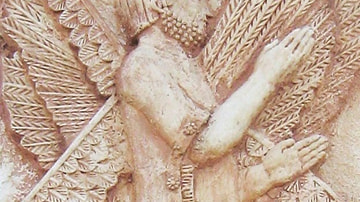
Cyrus the Great
Cyrus II (d. 530 BCE), also known as Cyrus the Great, was the fourth king of Anshan and the first king of the Achaemenid Empire. Cyrus led several military campaigns against the most powerful kingdoms of the time, including Media...

Definition
Nergal - The Mesopotamian God of Death, War, and Destruction
Nergal (also known as Erra and Irra) is the Mesopotamian god of death, war, and destruction. He began as a regional, probably agricultural, god of the Babylonian city of Kutha in the Sumerian...
