
Search
Remove Ads
Advertisement
Search Results

Image
Priestess of the Sun Necklace
This necklace made of clay was found in a grave alongside other ornaments and two veil holders. It dates from the 5th-4th century BCE and was found at the Necropolis of Navafría, Clares (Maranchón, Guadalajara), Spain...

Definition
Xochipilli
Xochipilli or the 'Prince of Flowers' was the Mesoamerican god of summer, flowers, pleasure, love, dancing, painting, feasting, creativity and souls. He is a benevolent manifestation of Piltzintecuhtli, the young sun god who was himself...

Definition
Koh-i-Noor
The Koh-i-Noor diamond (also Koh-i-Nur or Kūh-e Nūr) is one of the largest and most famous cut diamonds in the world. It was most likely found in southern India between 1100 and 1300. The name of the stone is Persian meaning ‘Mountain...

Article
The Ball Game of Mesoamerica
The sport known simply as the Ball Game was played by all the major Mesoamerican civilizations and the impressive stone courts became a feature of many cities. More than just a game, it could have a religious significance...

Definition
Egyptian Obelisk
An obelisk is a stone rectangular pillar with a tapered top forming a pyramidion, set on a base, erected to commemorate an individual or event and honor the gods. The ancient Egyptians created the form at some point in the Early...

Definition
Aristarchus of Samos
Aristarchus of Samos (l. c. 310 - c. 230 BCE) was a Greek astronomer who first proposed a heliocentric model of the universe in which the sun, not the earth, was at the center. Although his theory was noted by other thinkers...

Video
Surya - The Sun God
Surya is the chief solar deity in Hinduism, one of the Adityas. The term Surya also refers to the Sun, in general. Surya has hair and arms of gold. In Hindu religious literature, Surya is notably mentioned as the visible form...

Definition
Pedro de Alvarado
Pedro de Alvarado (c. 1485-1541) was a Spanish conquistador who became the first governor of Guatemala in 1527. Living an extraordinary life of adventure, Alvarado participated in separate expeditions to Mexico, Central America...
Article
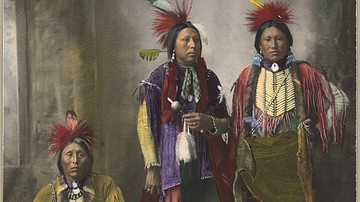
Saynday Tales
Saynday tales are popular legends of the Kiowa nation featuring the trickster figure Saynday who, like other Native American tricksters, sometimes appears as a hero, sometimes as a villain, and other times as a clownish buffoon...

Image
Tonatiuh, Calendar Stone
The Aztec Sun Stone (also known as the Calendar Stone) is a representation of the five eras of the sun from Aztec mythology. Some scholars consider the central face to be that of Tonatiuh, the sun god, while others maintain...
