
Search
Remove Ads
Advertisement
Search Results

Image
Aztec victims of smallpox
Sixteenth-century Aztec drawings of victims of smallpox. Scanned from (2009) Viruses, Plagues, and History: Past, Present and Future, Oxford University Press, USA, p. 60.

Image
Aztec Warriors
Aztec warriors in typical costume of elite ranks with back racks displaying group insignia. They each carry an obsidian-bladed spear. From the Codex Mendoza, folio 67. (Bodleian Library, Oxford)

Image
Aztec Sun Stone, 1792 Illustration
Aztec Sun Stone, illustration in Antonio León y Gama's Historical and Chronological Description of the Two Stones Which Were Found in 1790 During the Repaving of the Main Plaza in Mexico, 1792. Antonio León y...
Image
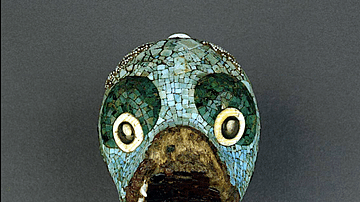
Aztec Turquoise Pendant
An Aztec pendant representing an animal head and covered in turquoise mosaic and with eyes rendered in shell and pyrite. 1400-1521, Mexico. Height 10 cm. (British Museum, London)
Image
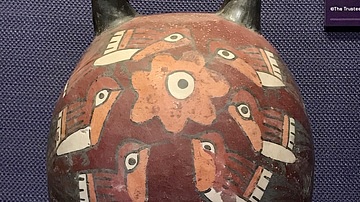
Aztec Hummingbird Whistling Pot
The Aztec civilization of ancient Mesoamerica believed that dead warriors were reincarnated as hummingbirds or butterflies. These whistling pots often included such birds, and they were considered spiritual conduits...
Image
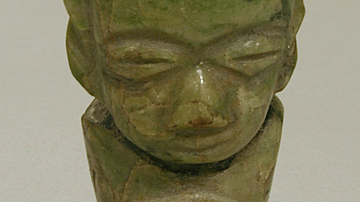
Aztec Jade Pendant
An Aztec jade pendant in the form of a figurine. 15th century. (Metropolitan Museum of Art, New York)

Video
The Pantheon, Rome
More free lessons at: http://www.khanacademy.org/video?v=KaY8zqYfQI0
Speakers: Dr. Beth Harris and Dr. Steven Zucker
Definition
Chocolate in Mesoamerica
Chocolate was one of the most desired foods of Mesoamerica and was consumed by the Olmec, Maya, and Aztec civilizations, amongst others. Its consumption even spread via trade routes to other parts of the Americas including...
Definition
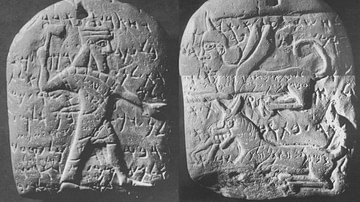
Arslan Tash Amulet
Dated to the 7th century BCE, the Arslan Tash amulet (AT1) was discovered in Arslan Tash, Syria and contains the writing of Phoenician, magic incantations. The limestone plaque includes a variety of features: incantations perceived...

Video
Aztec and Mayan Are Totally Different Languages. Sort of
Ancient Mexico was a hotbed of language mixing. Aztecs and Maya spoke completely unrelated languages, but a Mesoamerican linguistic mindmeld tied them together in surprising ways. Here's the grammar...
