
Search
Remove Ads
Advertisement
Search Results

Image
Pantheon Front, Rome
The front of the Pantheon in Rome, dated to the first part of emperor Hadrian’s reign, probably between 117-126-8 CE. Hadrian copied the inscription present on an earlier building that used to stand on the same spot, built...

Image
Pediment, Pantheon
The pediment of the pantheon in Rome, completed c. 125 CE. Once it would have carried a gilded bronze emblem, possibly an eagle and wreath.

Image
Artist's Impression of the Pantheon
An artist's representation of the Pantheon in Rome as it may have appeared when it was completed c. 125 CE. From the game Old World.

Image
Portico, Pantheon
The portico of the Pantheon in Rome, c. 135 CE.

Image
Hole in the Top of the Pantheon
The famous hole in the dome of the Pantheon, Rome. Built by Emperor Hadrian, c.125 CE, to honor all the gods in the Roman Empire. Later consecrated as a Christian Church under Constantine the Great.
Image
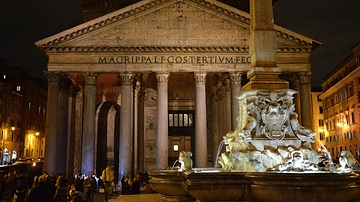
The Pantheon by night, Rome
The Pantheon is the best preserved building from ancient Rome and was completed in circa 125 CE in the reign of Hadrian.

Image
Dome of the Pantheon
Light entering the oculus of the Pantheon in Rome
Image
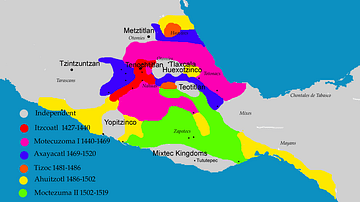
Expansion of the Aztec Empire
A map illustrating the various stages of Aztec expansion under successive rulers in the 15th and early 16th centuries CE.

Image
Aztec Turquoise Shield
An Aztec (Mexica) shield of wood covered in turquoise and shell mosaic. Likely used only as a ceremonial shield. The design shows solar disks and a long, winding snake crisscrossing the shield horizontally. The shield was...

Article
La Malinche - A Complicated Woman in Context
La Malinche, or Malintzin, was the primary interpreter in the retinue of Hernán Cortés during his conquest of Mexico in the early 16th century and has become one of the most divisive women in Mexican history...
