
Search
Remove Ads
Advertisement
Search Results

Image
Neo-Assyrian Empire c. 912-612 BCE
Map of the Neo-Assyrian Empire c. 912-612 BCE, showing expansion by Shalmeneser III (r. c. 859-824 BCE), Tiglath-Pileser III (r. c. 745-727 BCE), Sargon II (r. c. 722-705 BCE), Sennacherib (r. c. 705-681 BCE), and...

Video
Marcus Aurelius: The Philosopher & Emperor of the Roman Empire
Marcus Aurelius (r. 161 to 180 CE) was a Roman emperor best known as the last of the Five Good Emperors of Rome (following Nerva, Trajan, Hadrian, and Antoninus Pius) and as the author of the...

Image
Roads of the Roman Empire
This map shows all the major roads in the Roman Empire. This map was created for Ancient History Encyclopedia using the Antiquity A-La-Carte application by the Ancient World Mapping Center at UNC Chapel Hill under a Creative...

Video
Marriage in the Ancient Roman Empire
Love, sex, and marriage in ancient Rome were defined by the patriarchy. The head of the household was the father (the pater familias) who had complete control over the lives of his wife, children, and slaves. This...
Image
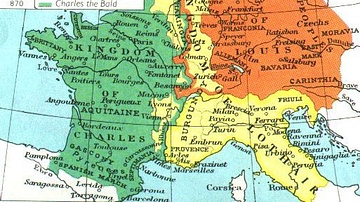
Division of the Carolingian Empire in 843 & 870 CE
Map of the Carolingian empire following its division in the 9th Century CE. The Treaty of Verdun in 843 CE partitioned the Kingdom of the Franks into West Francia (green), East Francia (orange), and...

Image
Map of the Growth of Christianity in the Roman Empire - From Early Communities to Imperial Christianity, 30–451
The growth of Christianity in the Roman Empire from the 1st to the 5th centuries transformed a small religious movement rooted in Roman Judaea into one...

Definition
Edward Gibbon
Edward Gibbon (1737-1794) was an English historian most famous for his influential work The History of the Decline and Fall of the Roman Empire, volume one of which was published in 1776, with the final sixth volume coming in 1788...

Definition
Attila the Hun
Attila the Hun (r. 434-453 CE) was the leader of the ancient nomadic people known as the Huns and ruler of the Hunnic Empire, which he established. His name means "Little Father" and, according to some historians, may not have...

Definition
Ashurbanipal
Ashurbanipal (r. 668-627 BCE, also known as Assurbanipal) was the last of the great kings of Assyria. His name means "the god Ashur is creator of an heir" and he was the son of King Esarhaddon of the Neo-Assyrian Empire. In the Hebrew...

Definition
Mansa Musa I - The Richest Man in History?
Mansa Musa I was the ruler of the Mali Empire in West Africa from 1312 to 1337. Controlling territories rich in gold and copper, and monopolising trade between the north and interior of the continent, Mali...
