
Search
Remove Ads
Advertisement
Search Results

Definition
Persian Immortals
The Ten Thousand Immortals were the elite force of the Persian army of the Achaemenid Empire (c. 550-330 BCE). They formed the king's personal bodyguard and were also considered the shock troops of the infantry in Persian warfare...

Definition
Möngke Khan
Mongke Khan was ruler of the Mongol Empire (1206-1368 CE) from 1251 to 1259 CE. As the third Great Khan or 'universal ruler' of the Mongols, Mongke would oversee administrative reforms that continued to centralise government and ensure...

Definition
Ancient Armenia
Ancient Armenia, located in the south Caucasus area of Eurasia, was settled in the Neolithic era but its first recorded state proper was the kingdom of Urartu from the 9th century BCE. Incorporated into the Persian Empire of Cyrus...

Video
Rome: An Empire's Story with Greg Woolf
In our interview with Greg Woolf, we chat all about the second edition of his book Rome: An Empire's Story. What's the book about? Well, It's a total history of Rome. It starts with the 8th century BCE, when...

Definition
Kukulcan - The Feathered-Serpent God of Mesoamerica
Kukulcan (pron. Koo-kool-kan) is the name of a feathered serpent god in the mythology and religion of Mesoamerica, in particular, the Yucatec Maya. He is also identified as the feathered serpent god...
Definition
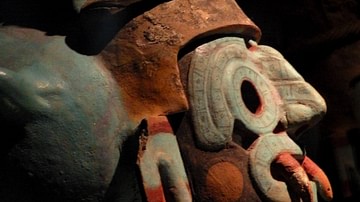
Tlaloc
Tláloc (pron. Tla-loc) is one of the most important and formidable gods in the Aztec pantheon. He was considered the god of rain, water, lightning and agriculture. Tlaloc was seen as both a benevolent god providing life-giving rain but...

Image
Map of the Inca Empire (Tawantinsuyu, c. 1438–1533) - Expansion Across South America, Cities and Roads
The Inca Empire (Tawantinsuyu, c. 1438–1533) grew from a highland kingdom centered on Cusco into the largest empire in pre-Columbian America. Under Pachacuti...

Image Gallery
The Roman Empire in 10 Maps
In this gallery, we examine the evolution of the Roman Empire through 10 detailed maps. From Julius Caesar's victories to the splitting of the empire, these maps trace the geographical growth, the intricate trade network...

Image
The Five Good Emperors of the Roman Empire (96 - 180 CE)
This infographic illustrates the succession of Roman emperors from 96 to 180 CE, commonly referred to as the Five Good Emperors - Nerva, Trajan, Hadrian, Antoninus Pius, and Marcus Aurelius. This...

Video
The Persian Wars: Ancient Greece vs. the Achaemenid Persian Empire
The Persian Wars, also known as the Greco Persian Wars, were a series of battles fought between Ancient Greece and the Achaemenid Persian Empire in the 5th century BCE. The most famous of...
