
Search
Remove Ads
Advertisement
Search Results

Article
La Malinche - A Complicated Woman in Context
La Malinche, or Malintzin, was the primary interpreter in the retinue of Hernán Cortés during his conquest of Mexico in the early 16th century and has become one of the most divisive women in Mexican history...

Image
Map of the Rise and Fall of the Mexica (Aztec) Empire - Alliance, Expansion, and Tribute Power in Mesoamerica
The Mexica (commonly referred to as the Aztecs) emerged as a dominant power in central Mexico during the Late Postclassic period, culminating in the formation...
Definition
Chocolate in Mesoamerica
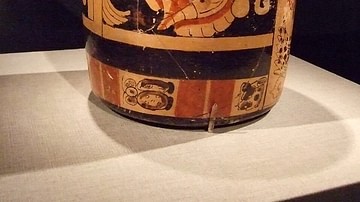
Chocolate was one of the most desired foods of Mesoamerica and was consumed by the Olmec, Maya, and Aztec civilizations, amongst others. Its consumption even spread via trade routes to other parts of the Americas including...

Video
A Day in the Life of an Aztec Midwife
Join the Aztec midwife Xoquauhtli as she tends to her patients and honors the warrior goddess Teteoinnan at a festival ushering in the season of warfare. — The midwife Xoquauhtli has a difficult choice to...

Definition
Tarascan Civilization
The Tarascan civilization (aka the Purépecha, after their language) dominated western Mexico and built an empire that would bring it into direct conflict with that other great Mesoamerican civilization of the Post-classic...

Article
Day of the Dead
The Day of the Dead, known in Spanish as Día de los Muertos, is a holiday that celebrates life and honors the dead through traditions, food, decorations, and activities intended to sustain the connections between the living and...

Video
The Sun Stone (The Calendar Stone), Aztec
The Sun Stone (or The Calendar Stone), Aztec, reign of Moctezuma II (1502-20), discovered in 1790 at the southeastern edge of the Plaza Mayor (Zocalo) in Mexico City, stone (unfinished), 358 cm diameter...

Article
Turquoise in Mesoamerica
Turquoise was a highly-prized material in ancient Mesoamerica, perhaps the most valued of all materials for sacred and decorative art objects such as masks, jewellery, and the costumes of rulers and high priests. Turquoise...

Image
Atlalli Aztec Irrigation
Atlalli, ink on parchment, unknown artist, included in the Florentine Codex by Bernardino de Sahagún, Mexico, 1577. A farmer in Mexico cultivates irrigated land. Water has a swirling texture while the land is sparsely...
Image
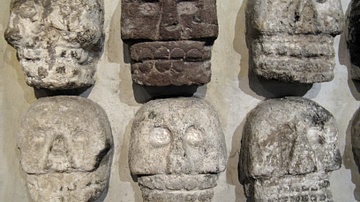
Aztec Skulls, Templo Mayor
Stone skulls from the Templo Mayor in the Aztec capital of Tenochtitlan. They represent the tzompantli or skull racks where the heads of sacrificial victims were placed.
