
Search
Remove Ads
Advertisement
Search Results
Definition
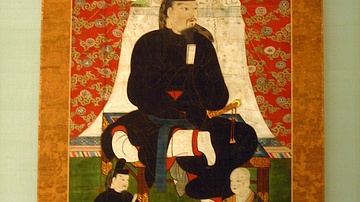
Fujiwara Clan
The Fujiwara clan (Fujiwara-shi) was a powerful extended family group which dominated all areas of Japanese government during the Heian Period (794-1185). Founded by Fujiwara no Kamatari in 645 CE, male members held on to key official positions...

Article
Life in a Japanese Buddhist Monastery
Buddhist monasteries have been part of the Japanese cultural landscape ever since the 7th century CE, and they remained both powerful and socially important institutions right through the medieval period. Today, many of Japan's finest examples...

Article
Ancient History Encyclopedia in Japan
The “Ancient Japan” initiative at Ancient History Encyclopedia arose as there is a dearth of open access and digitally curated information concerning early Japanese history available online and in English. East and Southeast Asia are arguably...

Definition
Shogun
The shoguns of medieval Japan were military dictators who ruled the country via a feudal system where a vassal's military service and loyalty was given in return for a lord's patronage. Established as an institution by the first shogun proper...

Image
Periods of Ancient Japanese History
An image illustrating the progression of periods in ancient Japanese civilization from its pre-historic settling by paleolithic migrants from northeast Asia. Through profound domestic evolution and constant international exchange during the...

Image
Central Gate & Pagoda, Horyuji Temple
The Chumon or central gate and five-storey pagoda of the Buddhist temple Horyuji, Nara, Japan. It is the most important Buddhist temple in Japan and was first built in 607 CE by Prince Shotoku during the Asuka Period. The temple was destroyed...
Image
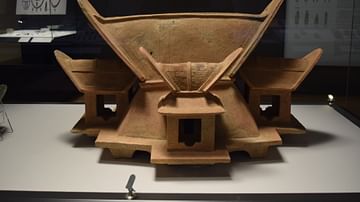
Haniwa House
A terracotta haniwa (tomb marker) in the form of a house. Saitobaru Burial Mounds, Saito-shi, Miyazaki, Japan. Kofun/Asuka Period, 5th century CE, Japan. Imperial Cultural Property. (Tokyo National Museum)
Image
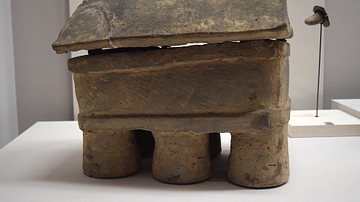
Japanese Earthenware Coffin
An earthenware coffin. Kawanabe, Tsuyama-shi, Okayama, Japan. Asuka Period, 7th century CE. (Tokyo National Museum)
Definition
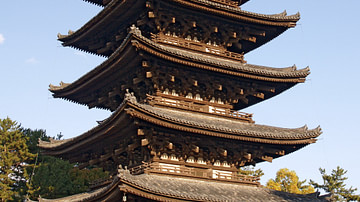
Kofukuji
Kofukuji is a Buddhist temple which was founded in 669 CE and relocated to its present location in Nara, Japan in 710 CE. It was the main Buddhist temple of the influential Fujiwara clan during the Heian Period (794-1185 CE). The temple's...

Collection
Japan in Medieval Times
The history of medieval Japan (1185-1603 CE) involved the rise of the military and such figures as the shoguns and samurai but there were many other cultural developments in between and during the many wars that troubled the country. In this...
