
Search
Remove Ads
Advertisement
Search Results
Image
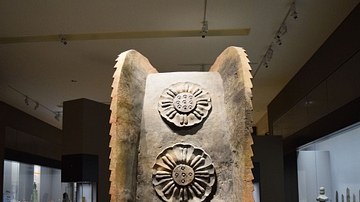
Japanese Ridge-End Ornament
This large block comes from the ruins of Tosaka-dera (Takaidahaiji) in Osaka, Japan. It dates from the Asuka period or the Nara period in Japanese history, which overlapped with the 7th and 8th century CE. (Tokyo National Museum)
Article
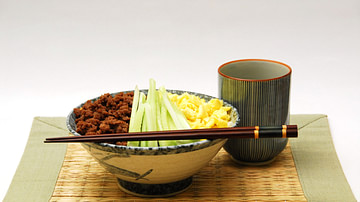
Food & Agriculture in Ancient Japan
The diet of ancient Japan was heavily influenced by its geography as an archipelago, foodstuffs and eating habits imported from mainland Asia, religious beliefs, and an appreciation for the aesthetic appearance of dishes, not just the taste...
Image
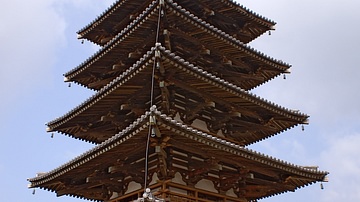
Pagoda, Horyuji
The five-storey pagoda of the Buddhist Horyuji monastery, Nara, Japan. 607 CE. The pagoda is over 35 metres (100 ft.) high.
Image
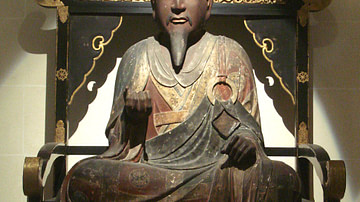
Prince Shotoku Statue
A statue of Prince Shotoku, the legendary Japanese ruler and founder of Japanese Buddhism (r. 594-622 CE). (Musee Guimet, Paris)

Image
Main Hall, Horyuji
The Main Hall (aka Golden Hall) or Kondo of the Buddhist Horyuji monastery, Nara, Japan. 607 CE.
Image
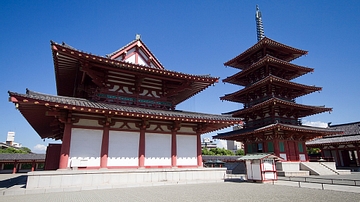
Shitenno-ji Temple, Osaka
The Buddhist Shitenno-ji temple in Osaka, Japan. Reportedly founded by Prince Shotoku in 530 CE.
Image
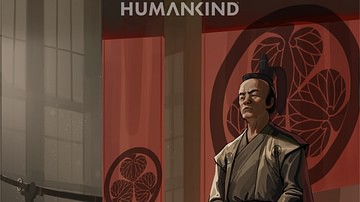
Samurai Bow Before The Shogun
Artist's impression of samurai before their shogun, inside a ceremonial building. Created by Amplitude Studios for the video game Humankind.
Image
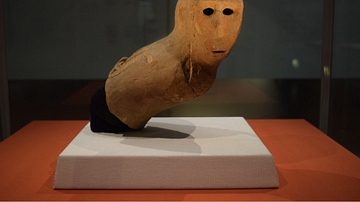
Monkey Haniwa
A terracotta haniwa (tomb marker) in the form of a monkey. 6th century CE, Kofun/Asuka Period. From Dainichizuka Tumulus, Okinosu, Namegata-shi, Ibaraki, Japan. 'Important Cultural Property'. (Tokyo National Museum)
Image
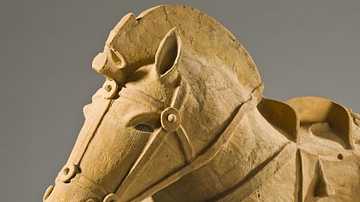
Haniwa Horse
A terracotta haniwa (tomb-marker) in the form of a horse. Asuka Period, 6th century CE, Japan. (Los Angeles County Museum of Art)
Video
Prince Shotoku: Japan's Golden Age
This video describes the reign of Prince Shotoku during Japan's Golden Age, and his influence in spreading Buddhism in Japan, followed by China.
