
Search
Remove Ads
Advertisement
Search Results

Video
English Civil War Reenactment Battle Display! BIGGEST EVER! Military Odyssey 2013 | HD Video
English Civil War Reenactment Battle Display! BIGGEST EVER! Military Odyssey 2013: The biggest and most impressive English Civil War Battle display I've ever seen! For my video camera is use a Canon EOS 60D DSLR Camera (Canon Digital...

Definition
Ancient Persian Government
The government of ancient Persia was based on an efficient bureaucracy which combined the centralization of power with the decentralization of administration. The Achaemenid Empire (c. 550-330 BCE) founded by Cyrus the Great (r. c. 550-530...

Video
Marian Reforms and their Military Effects
By the end of the II century BC, Rome became the dominant state in the Mediterranean, defeating Carthage, Macedon and the Seleucids, yet the internal problems and the arrival of the Germanic Cimbri showed that the victorious Roman legions...
Image
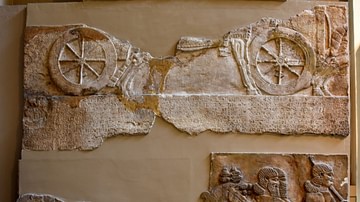
Assyrian Chariots
Assyrian wall panel, from the Central Palace at Nimrud (ancient Kalhu), Mesopotamia, modern-day Iraq, reused later in the South-West Palace, from the reign of Tiglath-Pileser III, c. 728 BCE. One of a series, it shows two disconnected scenes...
Image
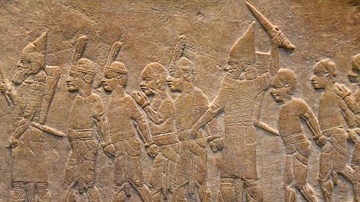
Assyrian Soldiers with Nubian Prisoners
This is a detail of a large gypsum wall panel. The panel depicts the Assyrian attack on a fortress at the Egyptian city of Memphis in 667 BCE. Here the Nubian soldiers of King Taharqa (of the 25th Dynasty) are being led, as prisoners, by...

Definition
Nebuchadnezzar II
Nebuchadnezzar II (r. 605/604-562 BCE) was the greatest King of ancient Babylon during the period of the Neo-Babylonian Empire (626-539 BCE), succeeding its founder, his father, Nabopolassar (r. 626-605 BCE). He is best known from the biblical...
Image
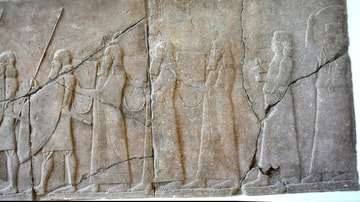
Assyrian Wall Relief Depicting Musical Instruments
Alabaster bas relief depicting marching shield bearers accompanied by a group of musicians who carry different musical instruments, from Nineveh, northern Mesopotamia, Iraq, Neo-Assyrian Empire, reign of king Sennacherib, 705-681 BCE. The...

Image
Assyrian War Relief Panel, Nimrud
Alabaster bas-relief showing Assyrian soldiers playing catch with decapitated heads of their enemies. Neo-Assyrian Period, 865-860 BCE. Detail of Panel 6 (top), Room B, the North-Palace Palace, Nimrud, modern-day Iraq. (The British Musuem...
Image
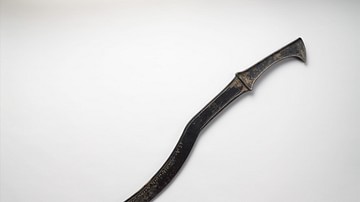
Assyrian Sickle Sword
A bronze Assyrian sickle sword that is believed to have belonged to the Assyrian king Adad Nirari I (r. 1307-1275 BCE), made in northern Mesopotamia, c. 13th century BCE. The blade bears the cuneiform inscription: "Palace of Adad-nirari...
Image
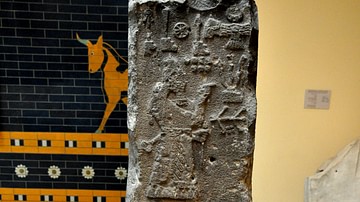
Stela of the Assyrian King Adad Nirari III
Stela of Adad Nirari III, erected by one of the king's local governors, Nergal-Eres, found in Saba, Neo-Assyrian Empire, 810-783 BCE. The stela features the Assyrian King Adad Nirari III praying in front of god symbols, and the inscriptions...
