
Search
Remove Ads
Advertisement
Search Results
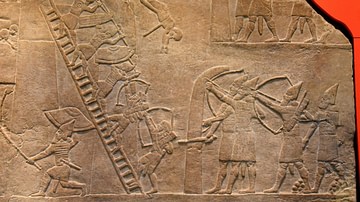
Image
Assyrian Archers Attacking an Egyptian Fortress at Memphis
Detail of a large gypsum wall panel showing the Assyrian army attacking the Egyptian city of Memphis and commemorating the final victory of the Assyrian king Ashurbanipal II over the Egyptian king Taharqa in 667 BCE. Panel 17, Room M of the...

Definition
Ancient Syria
Syria is a country located in the Middle East on the shore of the Mediterranean Sea and bordered, from the north down to the west, by Turkey, Iraq, Jordan, Israel, and Lebanon. It is one of the oldest inhabited regions in the world with archaeological...

Definition
Kalhu / Nimrud
Kalhu (also known as Caleh, Calah, and Nimrud, in modern-day northern Iraq) was a city in ancient Mesopotamia that became the capital of the Assyrian Empire under Ashurnasirpal II (r. 884-859 BCE) who moved the central government there from...
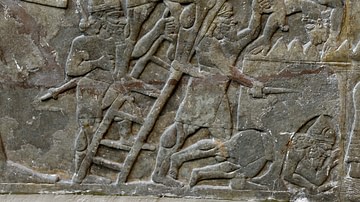
Image
Assyrian Army Besieges a City
Alabaster bas-relief depicting an attack on a city by the Assyrian army. Detail of Panel 5 (bottom), Room B, the North-Palace Palace, Nimrud, modern-day Iraq, Neo-Assyrian Empire, 865-860 BCE.
The British Museum, London.
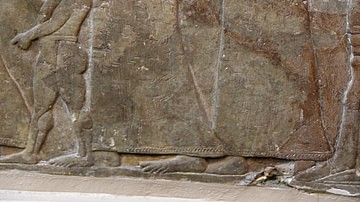
Image
Assyrian Prisoners of War
Alabaster bas-relief showing two women and a child as prisoners of war after the Assyrian army captured their city, detail of Panel 5 (bottom), Room B, the North-Palace Palace, Nimrud, modern-day Iraq, Neo-Assyrian Empire, 865-860 BCE. The...
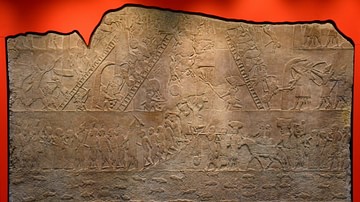
Image
Assyrian Army Attacking Memphis
Gypsum panel showing the Assyrian army attacking the Egyptian city of Memphis and commemorating the final victory of the Assyrian king Ashurbanipal II over the Egyptian king Taharqa in 667 BCE. Panel 17, Room M of the North Palace at Nineveh...
Image
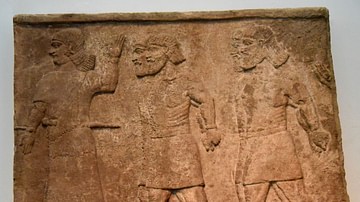
Assyrian Warriors Relief
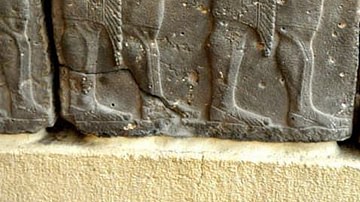
Basalt reliefs depicting Assyrian warriors of different ranks in procession with a royal chariot led by the commander-in-chief of the Assyrian army. The reliefs were acquired and gathered during the years 1848, 1946, 1948, 1982, and 1995...
Image
Review of Arab Prisoners, Assyrian Relief
Assyrian relief, from the Central Palace at Nimrud (ancient Kalhu), Mesopotamia, Iraq, Neo-Assyrian Empire, c. 728 BCE. This is part of a series of reliefs showing Arab prisoners brought before the Assyrian King Tiglath-Pileser III (r. 744-727...

Article
Winning Against the Odds: Sargon II & the Urartu Campaign
It is often when one is faced with the most difficult circumstances that one is given the greatest opportunity for clarity. History provides ample evidence of this experience in showing how, when faced with seemingly impossible situations...

Image
Map of the Assyria in the Middle Assyrian Period - Campaigns and Rival Powers in the Late Bronze Age
The Middle Assyrian period (c. 1365–1000 BCE) emerged from the shifting balance of power in the Late Bronze Age Near East. After earlier subordination to Mitanni, Assyria reasserted its autonomy under Ashur-uballit I (reign c. 1365–1330 BCE...
