
Search
Did you mean: Aria?
Remove Ads
Advertisement
Search Results
Definition
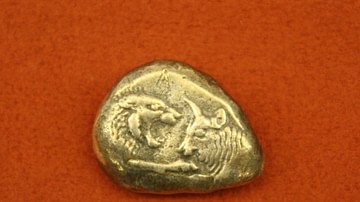
Lydia
Lydia was a region of western Asia Minor which prospered due to its natural resources and position on trading routes between the Mediterranean and Asia. The Kingdom of Lydia flourished in the 7th and 6th centuries BCE and expanded to...

Article
Cultural Links between India & the Greco-Roman World
Cyrus the Great (558-530 BCE) built the first universal empire, stretching from Greece to the Indus River. This was the famous Achaemenid Empire of Persia. An inscription at Naqsh-i-Rustam, the tomb...

Article
Battle of the Eurymedon, c. 466 BCE
The Battle of the Eurymedon (c. 466 BCE, also given as the Battle of the Eurymedon River) was a military engagement between the Greeks of the Delian League and the forces of the Achaemenid Empire toward the end...
Article
Melito of Sardis and his Apology for Christianity
Melito of Sardis (d. c. 180 CE) was a bishop in the city of Sardis (near modern-day Sart, Turkey) who was regarded as one of the greatest Christian thinkers, writers, and apologists of his time. In the...

Definition
White Huns (Hephthalites)
The White Huns were a race of largely nomadic peoples who were a part of the Hunnic tribes of Central Asia. They ruled over an expansive area stretching from the Central Asian lands all the way to the Western Indian Subcontinent...

Definition
John Cabot
John Cabot (aka Giovanni Caboto, c. 1450 - c. 1498 CE) was an Italian explorer who famously visited the eastern coast of Canada in 1497 CE and 1498 CE in his ship the Mathew (also spelt Matthew). Sponsored by Henry VII of England...

Definition
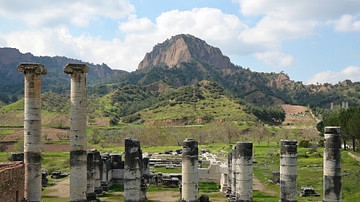
Sardis
Sardis (near modern-day Sart, Turkey) was the capital of the ancient Kingdom of Lydia founded (according to Herodotus) by the Heracleidae, the Heraclid Dynasty descended from the hero Heracles (Hercules). The city was famous in antiquity...

Definition
Lysimachus
Lysimachus (c. 361-281 BCE) was one of Alexander the Great's trusted bodyguards and a member of his Companion Cavalry. Although he obtained Macedonian citizenship, his father was a Thessalian named Agathocles. After the death of Alexander...

Article
Early Human Migration
Disregarding the extremely inhospitable spots even the most stubborn of us have enough common sense to avoid, humans have managed to cover an extraordinary amount of territory on this earth. Go back 200,000 years, however...

Definition
Marco Polo
Marco Polo (1254-1324 CE) was a Venetian merchant and explorer who travelled to China and served the Mongol ruler Kublai Khan (l. 1214-1294 CE) between c. 1275 and 1292 CE. Polo's adventures are recounted in his own writings, The...
