
Search
Remove Ads
Advertisement
Search Results
Image
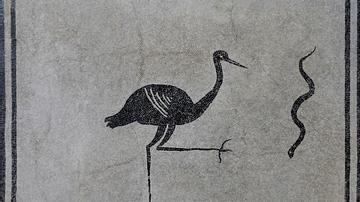
Black and White Mosaic with Stork and Snake
Black and white mosaic floor depicting a stork advancing towards a snake. From the caldarium (hot room of a Roman bath) of Villa della Pisanella at Boscoreale, third quarter of 1st century CE. Now in the Antiquarium of Boscoreale, Italy.
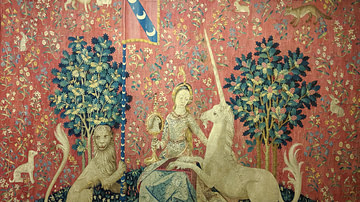
Image Gallery
The Lady and the Unicorn: Medieval Tapestries
The Lady and the Unicorn tapestries, housed at the Musée de Cluny in Paris, are a series of six exquisite medieval tapestries that are renowned for their beauty, craftsmanship, and mysterious symbolism. These tapestries are believed to have...

Article
The Delian League, Part 6: The Decelean War and the Fall of Athens (413/2-404/3 BCE)
This text is part of an article series on the Delian League. The sixth and last phase of the Delian League begins with the Decelean War, also referred to as the Ionian War, and ends with the surrender of Athens (413/2 – 404/3 BCE). The final...

Article
The Lamentations of Isis and Nephthys
The Lamentations of Isis and Nephthys is an ancient Egyptian text in which the two goddess-sisters call the soul of the god Osiris to rejoin the living. The poem takes the form of a call-and-response liturgy and the dual entreaties of the...

Video
The Concept and Symbol of Yin and Yang Explained
The principle of Yin and Yang dates from the third century BCE and perhaps even later than that, and is the foundational principle of Chinese philosophy and Chinese medicine. Yin and Yang is a symbol of balanced opposites, where they are...

Article
Mortimer and Isabella - The Lovers Who Brought Down a King
On 22 September 1326, a strong wind carried 95 ships from the shores of Flanders into the foamy maw of the North Sea. The weather was fair for the first hours of their voyage, but gradually, blue morning skies were replaced by seething dark...

Article
Interrelations of Kerma and Pharaonic Egypt
The vacillating nature of Ancient Egypt's associations with the Kingdom of Kerma may be described as one of expansion and contraction; a virtual tug-of-war between rival cultures. Structural changes in Egypt's administration led to alternating...

Article
Polybius' Capture of Achaeus and Fall of Sardis
Polybius' Capture of Achaeus and Fall of Sardis is the account of the end of the Siege of Sardis (215-213 BCE) by Antiochus III (aka Antiochus the Great, r. 223-187 BCE) of the Seleucid Empire after the betrayal and capture of his cousin...

Article
The Propaganda of Octavian and Mark Antony's Civil War
Propaganda played an important role in Octavian (l. 63 BCE - 14 CE) and Mark Antony's (l. 83 – 30 BCE) civil war, and once victorious at the Battle of Actium (31 BCE), Octavian returned home to become the first Roman emperor. The decade preceding...

Article
Kingdom of Magadha: Wars and Warfare
In ancient India from the 6th century BCE onwards, the kingdom of Magadha (6th century BCE to 4th century BCE) made a mark for itself. Located in the eastern part of India in what is today the state of Bihar, it outshone other kingdoms and...
