
Search
Remove Ads
Advertisement
Search Results

Definition
Apsaras and Gandharvas
In the Vedas, the apsaras are water nymphs, often married to the gandharvas. By the time the Puranas and the two epics were composed, the apsaras and gandharvas had become performing artists to the gods; the apsaras are singers, dancers...

Definition
Gandhara Civilization
The Gandhara Civilization existed in what is now Northern Pakistan and Afghanistan from the middle of the 1st millennium BCE to the beginning of the 2nd millennium CE. Although multiple major powers ruled over this area during that time...

Definition
Hinduism
Hinduism is the oldest religion in the world, originating in Central Asia and the Indus Valley, still practiced in the present day. The term Hinduism is what is known as an exonym (a name given by others to a people, place, or concept) and...

Definition
The Vedas
The Vedas are the religious texts which inform the religion of Hinduism (also known as Sanatan Dharma meaning “Eternal Order” or “Eternal Path”). The term veda means “knowledge” in that they are thought to contain the fundamental knowledge...

Definition
Indra - The Vedic Religion's Greatest God
The anthropomorphic god Indra was the most important god in the Vedic religion and he later became a major figure in Hinduism and an important deity in Buddhism, Cham and Chinese tradition. For the Aryas he was their national god and he was...

Definition
Soma - The Elixir of the Hindu Gods
Soma was a fermented juice drink which was believed to have been consumed by the Hindu gods and their ancient priests, the brahmanas, during rituals. Thought to be an elixir its consumption not only healed illness but also brought great riches...
Article
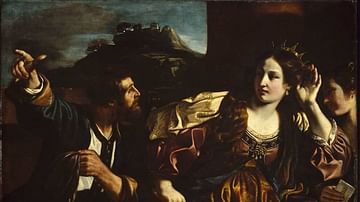
Sammu-Ramat and Semiramis: The Inspiration and the Myth
Sammu-Ramat (r. 811-806 BCE) was the queen regent of the Assyrian Empire who held the throne for her young son Adad Nirari III (r. 811-783 BCE) until he reached maturity. She is also known as Shammuramat, Sammuramat, and, most notably, as...
Article
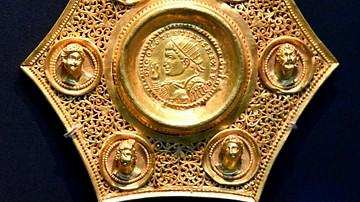
Government and Taxes under Diocletian and Constantine
The state created by Diocletian and Constantine used to be described as despotic and oppressive, extracting higher taxes and threatening its subjects with punishments for non-compliance. Recent research, however, paints a different picture...

Definition
Mesopotamian Art and Architecture - The Birth of Art and Architecture in the Ancient World
Ancient Mesopotamian art and architectural works are among the oldest in the world, dating back over 7,000 years. The works first appear in northern Mesopotamia prior to the Ubaid period (circa 6500-4000 BCE) and then developed in the south...

Article
Making and decorating Athenian black- and red-figure vases
The first stage in making a pot is to dig the clay out of the ground. Pieces of grit or plant matter must be removed before the clay can be used. This was done in ancient times, as it is today, by mixing the clay with water and letting the...
