
Search
Remove Ads
Advertisement
Search Results
Definition
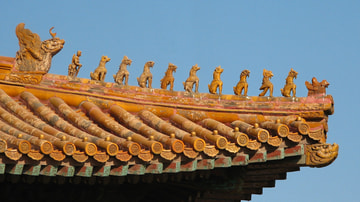
Ancient Chinese Architecture
Walled compounds, raised pavilions, wooden columns and panelling, yellow glazed roof tiles, landscaped gardens, and a careful application of town planning and use of space are all notable features of the architecture...

Definition
Ancient Greek Religion
In the ancient Greek world, religion was personal, direct, and present in all areas of life. With formal rituals which included animal sacrifices and libations, myths to explain the origins of mankind and give the gods a...

Definition
Byzantine Emperor
The Byzantine Emperor ruled as an absolute monarch in an institution which lasted from the 4th to 15th century CE. Aided by ministers, high-ranking nobility, and key church figures, the emperor (and sometimes empress) was commander-in-chief...

Video
Iranian/Persian Mythology, Part I, Ahriman, Zoroaster, Ahura Mazda, Mithras, Vayu, Tishtar, Apousha
Fereydoun Kian,(2009) Global Education Va, Vayu, Apousha, Tir, Tishtar, Nas, Nasa, Nasu, Dorooj, these are some of the Iranian Demons in ancient times and they...

Definition
God's Wife of Amun
The position of God's Wife of Amun was one of the most politically powerful and spiritually significant in later Egyptian history. Elevated from a figurehead in the New Kingdom (c.1570-1069 BCE), the God's Wife of Amun would...

Definition
Agora
The term agora (pronounced ah-go-RAH) is Greek for 'open place of assembly' and, early in the history of Greece, designated the area in a city where free-born citizens could gather to hear civic announcements, muster for military campaigns...

Article
Death in Ancient Egypt
To the ancient Egyptians, death was not the end of life but only the beginning of the next phase in an individual's eternal journey. There was no word in ancient Egyptian which corresponds to the concept of "death" as usually...

Definition
Battle of Thymbra
The Battle of Thymbra (547 BCE) was the decisive engagement between Cyrus II (the Great, r. c. 550-530 BCE) of Persia and Croesus (r. 560-546 BCE), King of Lydia. The Persian victory ended the Kingdom of Lydia, which was then...

Article
Alexander the Great & the Burning of Persepolis
In the year 330 BCE Alexander the Great (l. 356-323 BCE) conquered the Achaemenid Persian Empire following his victory over the Persian Emperor Darius III (r. 336-330 BCE) at the Battle of Gaugamela in...
Article
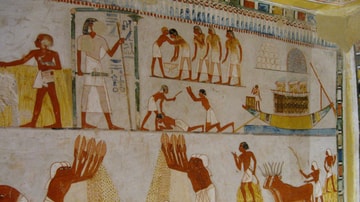
Jobs in Ancient Egypt
In ancient Egypt, the people sustained the government and the government reciprocated. Egypt had no cash economy until the coming of the Persians in 525 BCE. The people worked the land, the government collected the bounty...
