
Search
Remove Ads
Advertisement
Search Results

Article
Wine in the Ancient Mediterranean
Wine was the most popular manufactured drink in the ancient Mediterranean. With a rich mythology, everyday consumption, and important role in rituals wine would spread via the colonization process to regions all...
Image
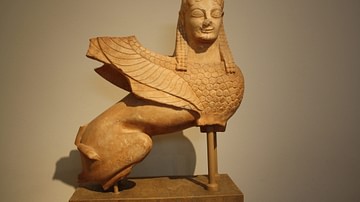
Greek Funerary Sphinx
A sphinx in pentelic marble, from a funerary stele, c. 570 BCE.
National Archaeological Museum, Athens.

Definition
Iliad
Homer's Iliad describes the final year of the Trojan War, a legendary conflict between an alliance of Greek cities and the city of Troy in Anatolia. It was probably written in the 8th century BCE after a long oral tradition. The Greeks...

Definition
Helios
Helios (also Helius) was the god of the Sun in Greek mythology. Helios rode a golden chariot which brought the Sun across the skies each day from the east (Ethiopia) to the west (Hesperides). Helios was famously the subject of the Colossus...
Image
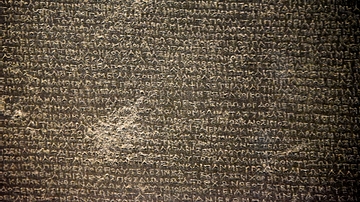
Rosetta Stone Detail, Greek Text
This is a zoomed-in detail of the lower part of the Rosetta stone showing the Greek text. The Rosetta Stone is a large almost complete fragment of a grey-pink granodiorite stela. A decree was carved on this stela...

Definition
Temple of Artemis at Ephesus
The Temple of Artemis at Ephesus was located on the western coast of Asia Minor (modern Turkey) and built in the 6th century BCE. Such was its tremendous size, double the dimensions of other Greek temples including the...

Article
Ten Ancient Mesopotamia Facts You Need to Know - Fun Facts on the Cradle of Civilization
Mesopotamia is the ancient Greek name (meaning "the land between two rivers," the Tigris and Euphrates) for the region corresponding to modern-day Iraq and parts of Iran...

Article
Ancient History Encyclopedia in Japan
The “Ancient Japan” initiative at Ancient History Encyclopedia arose as there is a dearth of open access and digitally curated information concerning early Japanese history available online and in English. East...

Article
Ten Famous & Not-so-Famous Same-Sex Couples in Ancient History
History is recorded by individual human beings with their own beliefs and interests guiding what they choose to record, and, as such, many events and details may be omitted from the account...
Definition
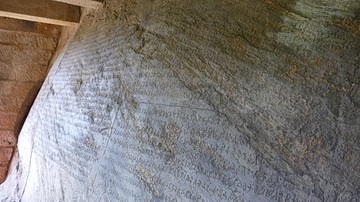
The Edicts of Ashoka the Great
The Edicts of Ashoka are 33 inscriptions engraved on pillars, large stones, and cave walls by Ashoka the Great (r. 268-232 BCE), the third king of the Mauryan Empire (322-185 BCE) of India. One set, the so-called Major...
