
Search
Remove Ads
Advertisement
Search Results

Image
Greek Tragedy Mask
A terracotta tragic theatre mask, 200-250 BCE. (Agora Museum, Athens)

Definition
Roman Art
The Romans controlled such a vast empire for so long a period that a summary of the art produced in that time can only be a brief and selective one. Perhaps, though, the greatest points of distinction for Roman art are its very diversity...

Image
The Twelve Elder Titans in Greek Mythology - according to Theogony (Generations of the Gods) by Hesiod
In early Greek cosmology, the Twelve Elder Titans were the children of the primordial deities Gaia (Earth) and Ouranos (Sky), representing an older divine order...

Article
Cosmetics in the Ancient World
The wearing of cosmetics and perfumes by both men and women goes back a very long way indeed as the ancients were just as keen as anyone to improve their appearance as quickly and as easily as possible using all manner...

Video
The Greek God Apollo: The Myths of the Olympian God of Music, Medicine, the Sun and Archery
The god Apollo in Greek mythology is the Olympian god of, well, quite a lot! Apollo is associated with the bow, music, divination, the sun, poetry, healing and medicine...

Image
Greek Terracotta Comedy Mask
A terracotta comedy mask, 200-250 BCE. (Agora Museum, Athens)
Image
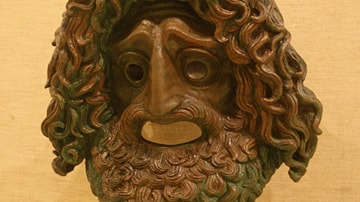
Greek Tragedy Theatre Mask
A votive offering in a the form of a larger-than-life bronze tragedy theatre mask. Possibly by Silanion, 4th century BCE. (Archaeological Museum of Piraeus)

Article
Ancient Celtic Society
The society of the Celts in Iron Age Europe was made up of several distinct hierarchical groups. At the top were rulers and elite warriors, then there were the religious leaders, the druids, and then specialised craftworkers...
Article
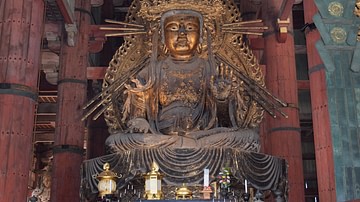
Buddhism in Ancient Japan
Buddhism was introduced to ancient Japan via Korea in the 6th century CE with various sects following in subsequent centuries via China. It was readily accepted by both the elite and ordinary populace because it confirmed...

Definition
Jupiter
Among the many gods of the Romans, Jupiter, the son of Saturn, was the supreme god, associated with thunder, lightning, and storms. The first citizens of what would become Rome believed they were watched over by the spirits of their...
