
Search
Remove Ads
Advertisement
Search Results

Definition
Indus Valley Civilization
The Indus Valley Civilization was a cultural and political entity which flourished in the northern region of the Indian subcontinent between c. 7000 - c. 600 BCE. Its modern name derives from its location in the valley...

Article
Ten Noble and Notorious Women of Ancient Greece
Women in ancient Greece, outside of Sparta, had almost no rights and no political or legal power. Even so, some women broke through the social and cultural restrictions to make their mark on history. All...

Article
LGBTQ+ in the Ancient World
In the cultures of the ancient world, there was no need for designations such as LGBTQ+ because there was no difference noted between what is now defined as "homosexual" and "heterosexual" relationships. There was no...
Image
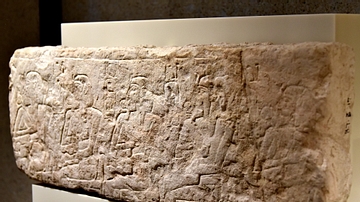
List of Five Pharaohs of the Egyptian Old Kingdom
This limestone fragment came from a New Kingdom tomb at Abusir/Saqqara, Egypt. The relief depicts five enthroned pharaohs, looking to the left. In front of the face of every one of them, a cartouche...

Image
Fayum Egyptian Funerary Portrait
Fayum funerary portrait of a man. Encaustic painting on wood (painting technique employing a heated or cold mixture of beewax with resin). 2nd century CE. (National Archaeological Museum of Athens, Greece)
Image
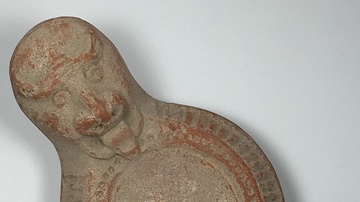
Egyptian Oil Lamp
This is a terracotta oil lamp with orange clay and dull orange slip. It features a hollow handle in the form of a gorgon's head. This is a decorative example of the type of oil lamp that was used to light one’s home. 2nd century...

Image
Model of an Egyptian Granary
Model of a granary. Wood. From Egypt, precise provenance is unknown. Middle Kingdom, 12th Dynasty, c. 1800 BCE. (The Neues Museum, Berlin, Germany).

Image
Egyptian Grinding Grain
This limestone statuette depicts a servant grinding grain on what appears to be a quern. Figurines and statuettes were placed insides tombs as early as the 1st Dynasty (3100-2890 BCE). The majority of them are doing bakery...

Image
Statue of Egyptian Family
A seated man is flanked by his son and daughter. Granite. From Western Thebes, Egypt. Middle Kingdom, 13th Dynasty, c. 1900 BCE. It is on display at the Neues Museum, Berlin, Germany.

Article
Shabti Dolls: The Workforce in the Afterlife
The Egyptians believed the afterlife was a mirror-image of life on earth. When a person died their individual journey did not end but was merely translated from the earthly plane to the eternal. The soul...
