
Search
Remove Ads
Advertisement
Search Results

Article
Ten Legendary Female Viking Warriors
In 2017 CE, Uppsala University archaeologist Charlotte Hedenstierna-Jonson published her study of a Viking grave discovered in Birka, Sweden in the 1800's CE which she and her team had revisited. She claimed that...

Article
Ancient Persian Gods, Heroes, and Creatures - The Complete List
The term 'mythology' comes from the Greek mythos (story-of-the-people) and logos (word or speech), meaning the spoken story of a people. Every civilization of the ancient world developed a...

Article
Setna II: A Detailed Summary & Commentary
Setna II (also Setna Khaemaus and Si-Osire) is a work of ancient Egyptian literature from Roman Egypt (30 BCE - 646 CE) written in demotic script. It is part of a cycle of stories known as the Tales of Prince...
Article
Herodotus on Burial in Egypt
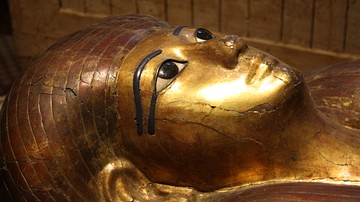
Herodotus' section of his Histories on burial in ancient Egypt (Book II.85-90) is an accurate description of Egyptian mummification, but he purposefully omits the spiritual significance of embalming in keeping with his...

Article
Norse-Viking Symbols & Meanings
A symbol is an image or object which represents an abstract concept, often having to do with one's religious beliefs. Every civilization, from the most ancient to the present, has made use of symbols to make the abstract...

Article
Dogs in Ancient Persia
Dogs have been an integral aspect of the human condition in virtually every world culture for thousands of years. Some of the greatest civilizations of the past have kept dogs as companions, for various chores, and featured...

Article
A Brief History of Egyptian Art
Art is an essential aspect of any civilization. Once the basic human needs have been taken care of such as food, shelter, some form of community law, and a religious belief, cultures begin producing artwork, and often...
Article
Immortality of Writers in Ancient Egypt
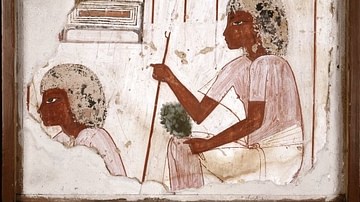
For the ancient Egyptians, life on earth was only one part of an eternal journey which continued after death. One's purpose in life was to live in balance with one's self, family, community, and the gods. Any...

Article
Roman Household Spirits: Manes, Panes and Lares
To the ancient Romans, everything was imbued with a divine spirit (numen, plural: numina) which gave it life. Even supposedly inanimate objects like rocks and trees possessed a numen, a belief which no...

Article
Religion in the Mongol Empire
The Mongol Empire (1206-1368 CE) covered Asia from the Black Sea to the Korean peninsula and so naturally included all manner of religions within its borders, but the Mongols themselves had their own particular religious...
