
Search
Remove Ads
Advertisement
Search Results

Article
Setna II: A Detailed Summary & Commentary
Setna II (also Setna Khaemaus and Si-Osire) is a work of ancient Egyptian literature from Roman Egypt (30 BCE - 646 CE) written in demotic script. It is part of a cycle of stories known as the Tales of Prince...

Article
The Mayan Pantheon: The Many Gods of the Maya
The pantheon of the Maya is a vast collection of deities worshipped throughout the regions of Yucatan, Quintana Roo, Campeche, Tabasco, and Chiapas in Mexico and southward through Guatemala, Belize, El...

Definition
Neith
Neith (aka Net, Neit or Nit) and is one of the oldest deities of ancient Egypt who was worshipped early in the Pre-Dynastic Period (c. 6000 - 3150 BCE) and whose veneration continued through the Ptolemaic Dynasty (323 - 30 BCE), the last...

Definition
Seshat
Seshat (also given as Sefkhet-Abwy and Seshet) is the Egyptian goddess of the written word. Her name literally means "female scribe" and she is regularly depicted as a woman wearing a leopard skin draped over her robe with a headdress...

Definition
Sleipnir
Sleipnir is the eight-legged horse ridden primarily by the god Odin in Norse mythology. He is the son of the god Loki (in the form of a mare) and the stallion Svadilfari who belonged to the jötunn that built the walls of Asgard. In...

Definition
Chogha Zanbil - The "Basket Mound" of the Gods
Chogha Zanbil (literally "basket mound") is an ancient Elamite temple complex located in the modern-day province of Khuzestan, Iran. It is also known as Dur-Untash (Fortress/City/Town of Untash), Tchogha...
Definition
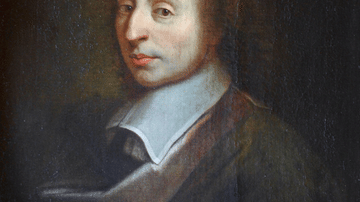
Blaise Pascal
Blaise Pascal (1623-1662) was a French scientist, mathematician, and philosopher whose work influenced both the Scientific Revolution and later European thought. Pascal is known for his practical achievements in science, such as...

Image Gallery
A Gallery of Ancient Egyptian Tombs, Coffins, and Grave Goods
Ancient Egyptian burial practices were observed as early as the Predynastic Period in Egypt (c. 6000 to c. 3150 BCE) and continued through the Ptolemaic Dynasty (323-30 BCE), serving to not...

Article
A Brief History of Egyptian Art
Art is an essential aspect of any civilization. Once the basic human needs have been taken care of such as food, shelter, some form of community law, and a religious belief, cultures begin producing artwork, and often...

Article
Most Popular Gods & Goddesses of Ancient China
There were over 200 gods and goddesses worshipped throughout ancient China, but if one were to count every deity or spirit, the number would be over 1,000. Each town, village, city, field, farm, and sometimes...
