
Search
Remove Ads
Advertisement
Search Results

Video
Lords of the Mountains: The Foundation of the Armenian Kingdom of Cilicia
For nearly three centuries between 1080 and 1375 a kingdom of exiles from the Armenian Plateau survived in the Taurus Mountains of modern day south-central Turkey. This is the story of the foundation of Armenian Cilicia during the maelstrom...

Video
Dacian Fortresses of the Orastie Mountains (UNESCO/NHK)
Built in the 1st centuries B.C. and A.D. under Dacian rule, these fortresses show an unusual fusion of military and religious architectural techniques and concepts from the classical world and the late European Iron Age. The six defensive...

Definition
Gutians - The Great Villains of the Sumerian Scribes
The Gutians were a West Asiatic people who are thought to have lived around the Zagros Mountains in a region referred to as Gutium. They had no written language and all that is known of them comes from their enemies, including the Akkadians...
Definition
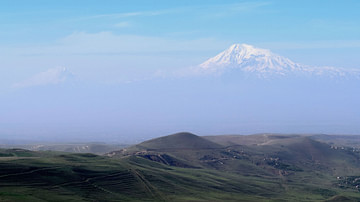
Mount Ararat
Mount Ararat (Armenian: Masis; Turkish: Ağrı Dağı; Kurdish: Çiyaye Agiri; Azeri: Ağrıdağ; Persian: Kūh-e Nūḥ) is a dormant, compound volcanic mountain, consisting of two ancient volcanic peaks, located in present-day eastern Turkey very close...

Definition
Sargon II
Sargon II (r. 722-705 BCE) was one of the most important kings of the Neo-Assyrian Empire as founder of the Sargonid Dynasty which would rule the empire for the next century until its fall. He was a great military leader, tactician, patron...

Definition
Achaemenid Empire
East of the Zagros Mountains, a high plateau stretches off towards India. While Egypt was rising up against the Hyksos, a wave of pastoral tribes from north of the Caspian Sea was drifting down into this area and across into India. By the...

Article
Inanna and Su-kale-tuda - An Ancient Condemnation of the Crime of Rape
Inanna and Su-kale-tuda (circa 1800 BCE) is a Mesopotamian myth dealing with rape and justice in ancient Sumer. The work has been interpreted as an astral myth or a figurative account of the rise of the southern states against Akkad, but...

Article
Lugalbanda and the Anzud Bird
Lugalbanda and the Anzud Bird is a Sumerian myth dated to the Ur III Period (2047-1750 BCE) featuring the hero-king of Uruk, Lugalbanda, father of Gilgamesh, in his younger years as an honorable officer in the army. Lugalbanda's purity of...

Definition
Mesopotamia - The Beginning of Beginnings
Mesopotamia (from the Greek, meaning "between two rivers") was an ancient region located in the Near East (Middle East) bounded in the northeast by the Zagros Mountains and in the southeast by the Arabian Plateau, corresponding to modern-day...

Article
Ghosts in Ancient Mesopotamia - Just Another Aspect of Life
Ghosts in ancient Mesopotamia were understood as a reality of life, just as they were in other civilizations of antiquity. Although the cultures of the various Mesopotamian civilizations differed between circa 5000 BCE and 651 CE, the belief...
