
Search
Remove Ads
Advertisement
Search Results

Definition
Sargon of Akkad - From Gardener to King of the Four Corners of the World
Sargon of Akkad (reign 2334-2279 BCE) was the king of the Akkadian Empire of Mesopotamia, the first multinational empire in history, who united the disparate kingdoms of the region under...

Definition
Constantine IV
Constantine IV ruled as emperor of the Byzantine empire from 668 to 685 CE. His reign is best remembered today for the five-year Arab siege of Constantinople from 674 CE, which the Byzantines resisted thanks to their strong fortifications...

Definition
Pharisees
The Pharisees were a Jewish sect that emerged c. 150 BCE and promoted the idea of priestly purity for all Jews, belief in providence or fate, and the concept of the resurrection of the dead, and taught that besides the commandments...

Definition
Thomas Müntzer
Thomas Müntzer (l. c. 1489-1525) was a German theologian and apocalyptic preacher who became one of the leaders of the German Peasants' War (1524-1525). An early follower of the reformer Martin Luther (l. 1483-1546), Müntzer established...

Definition
Andreas Karlstadt
Andreas Karlstadt (also given as Carlstadt, l. 1486-1541) was a reformer, theologian, and early supporter of Martin Luther (l. 1483-1546) in the movement that became known as the Protestant Reformation. Karlstadt was one of Luther's...

Definition
Centaur
A centaur was a creature from Greek mythology which was half-man and half-horse. The head, arms and torso of a centaur were human and joined at the waist to the body and legs of a horse. Centaurs represented barbarism and unbridled chaos...

Definition
Asclepius
Asclepius was the ancient Greek god of medicine, and he was also credited with powers of prophecy. The god had several sanctuaries across Greece; the most famous was at Epidaurus which became an important centre of healing in both...
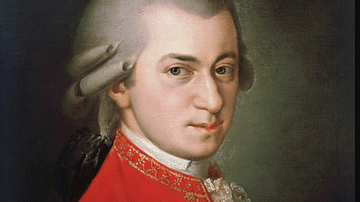
Definition
Wolfgang Amadeus Mozart
Wolfgang Amadeus Mozart (1756-1791) was an Austrian composer who wrote a wide range of works including piano concertos, string quartets, symphonies, operas, and sacred music. Regarded as one of or perhaps the greatest natural...

Definition
Thomas Hobbes
Thomas Hobbes (1588-1679) was an English philosopher who famously summarised his pessimistic view of human nature in his greatest work, Leviathan, published in 1651. Hobbes believed that the life of humanity in the state of nature...

Definition
Confucius
Confucius (Kongzi) was a 6th century BCE Chinese philosopher. His thoughts, expressed in the philosophy of Confucianism, have influenced Chinese culture right up to the present day. Confucius is a larger than life figure and it is...
