
Search
Remove Ads
Advertisement
Search Results

Definition
Esarhaddon
Esarhaddon (r. 681-669 BCE) was the third king of the Sargonid Dynasty of the Neo-Assyrian Empire. He was the youngest son of King Sennacherib (r. 705-681 BCE), and his mother was not the queen but a secondary wife, Zakutu (also known...

Definition
Etruscan Religion
The religion of the Etruscans, the civilization which flourished from the 8th to 3rd century BCE in central Italy, has, like many other features of the culture, long been overshadowed by that of its Greek contemporaries and Roman...

Definition
Edda
Edda is a term used to describe two Icelandic manuscripts that were copied down and compiled in the 13th century CE. Together they are the main sources of Norse mythology and skaldic poetry that relate the religion, cosmogony, and history...

Definition
Ashoka the Great
Ashoka the Great (r. 268-232 BCE) was the third king of the Mauryan Empire (322-185 BCE) best known for his renunciation of war, development of the concept of dhamma (pious social conduct), and promotion of Buddhism as well as...

Definition
Lebor Gabála Erenn
The Lebor Gabála Érenn or The Book of the Taking of Ireland, is a pseudo-historical collection of poetry and prose narrative which was first compiled in the 11th Century CE. The Lebor Gabála centers around an origin myth which...

Definition
Avesta
The Avesta is the scripture of Zoroastrianism which developed from an oral tradition founded by the prophet Zoroaster (Zarathustra, Zartosht) sometime between c. 1500-1000 BCE. The title is generally accepted as meaning “praise”, though...

Definition
Parthian Religion
Parthian religion might be best described with two words: inclusive and evolving. As Parthia's empire held within it a variety of cultures, the Parthians wisely left each to their own beliefs and traditions, like the Seleucid...

Definition
Martin Luther
Martin Luther (l. 1483-1546) was a German priest, monk, and theologian who became the central figure of the religious and cultural movement known as the Protestant Reformation. Even though earlier reformers had expressed Luther's...

Definition
Diego Velázquez de Cuéllar
Diego Velázquez de Cuéllar (also spelt Velásquez, 1465-1524) was a Spanish conquistador who conquered Cuba in 1511, became the island's first governor for the next decade, and sponsored expeditions of conquest directed...
Definition
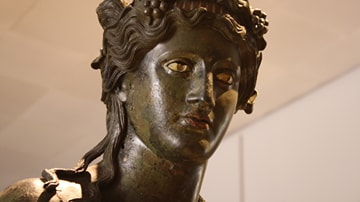
Dionysos
Dionysos (Roman name: Bacchus, also known as Dionysus) was the ancient Greek god of wine, merriment, and theatre. Being the bad boy of Mt. Olympus, Dionysus was perhaps the most colourful of the Olympian Gods. Son of Zeus In Greek...
