
Search
Did you mean: Writing?
Remove Ads
Advertisement
Search Results

Definition
Veii
Veii (modern name: Isola Farnese, in Etruscan: Vei), was an important Etruscan town located near the west coast of central Italy. Lying just 16 km north of Rome, it was the most southerly of the major Etrurian settlements. The prosperity...

Definition
Hanuman
Hanuman is one of several zoomorphic characters in Indian mythology, but is the only wholly animal figure who is revered as a god today. The mythic texts speak of him as a monkey child of the Wind God, as possessing enormous strength, keen...
Definition
Pindar
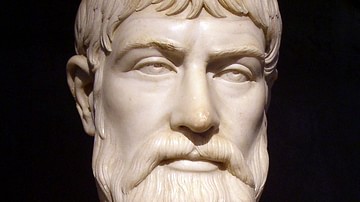
Pindar (c. 518 to c. 448/7 BCE) was an ancient Greek lyric poet, probably the greatest of his time. His works have been divided into 17 books of different types of poetry, but only those containing 44 choral victory songs composed for the...
Definition
Saint Cuthbert
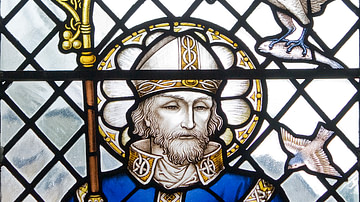
Saint Cuthbert (c. 634 - 20 March 687) was an Anglo-Saxon monk from the Kingdom of Northumbria, who became the bishop of Lindisfarne and one of the most important saints of the medieval church in England. He first became a monk at Melrose...
Definition
Acquarossa
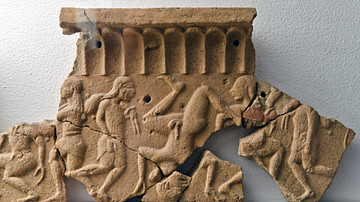
Acquarossa, located in the north of Italy's Lazio region, is the site of an Etruscan settlement of unknown name. Although much smaller than other, more famous Etruscan towns, Acquarossa has proved invaluable for archaeologists as it has not...

Article
Daily Life in Ancient Egypt
The popular view of life in ancient Egypt is often that it was a death-obsessed culture in which powerful pharaohs forced the people to labor at constructing pyramids and temples and, at an unspecified time, enslaved the Hebrews for this...

Article
Food & Drink in the Elizabethan Era
Food and drink in the Elizabethan era was remarkably diverse with much more meat and many more varieties of it being eaten by those who could afford it than is the case today. Storage of food was still a problem and so fresh produce was grown...

Article
Daily Life in Ancient China
Daily life in ancient China changed through the centuries but reflected the values of the presence of gods and one's ancestors in almost every time period. Villages like Banpo show evidence of a matriarchal society, where there was a priestly...

Article
Roman Daily Life
From the early days of the Roman Republic through the volatile reigns of such ignoble emperors as Caligula, Nero, and Commodus, the Roman Empire continued to expand, stretching its borders to encompass the entire Mediterranean Sea as well...

Article
Spartan Women
Spartan women had more rights and enjoyed greater autonomy than women in any other Greek city-state of the Classical Period (5th-4th centuries BCE). Women could inherit property, own land, make business transactions, and were better educated...
