
Search
Did you mean: Writing?
Remove Ads
Advertisement
Search Results

Article
Daily Life in Medieval Japan
Daily life in medieval Japan (1185-1606 CE) was, for most people, the age-old struggle to put food on the table, build a family, stay healthy, and try to enjoy the finer things in life whenever possible. The upper classes had better and more...

Article
Ancient Greek Inventions
The ancient Greeks are often credited with building the foundations upon which all western cultures are built, and this impressive accolade stems from their innovative contributions to a wide range of human activities, from sports to medicine...

Article
Daily Life in Ancient Mesopotamia - Mirroring the Modern World
Daily life in ancient Mesopotamia cannot be described in the same way one would describe life in ancient Rome or Greece. Mesopotamia was never a single, unified civilization, not even under the Akkadian Empire of Sargon of Akkad (the Great...

Article
Food & Drink in the Elizabethan Era
Food and drink in the Elizabethan era was remarkably diverse with much more meat and many more varieties of it being eaten by those who could afford it than is the case today. Storage of food was still a problem and so fresh produce was grown...

Article
Daily Life in Colonial America
Life in Colonial America was difficult and often short but the colonists made the best of their situation in the hopes of a better life for themselves and their families. The early English colonists, used to purchasing what they needed, found...

Article
Education in the Elizabethan Era
Besides the traditional option of private tuition, Elizabethan England (1558-1603 CE) offered formal education to those able to pay the necessary fees at preparatory schools, grammar schools, and universities. There was, however, no compulsory...

Article
Etruscan Tomb Paintings
The Etruscans flourished in central Italy from the 8th to 3rd century BCE, and one of their greatest legacies is the beautifully painted tombs found in many of their important towns. Tarquinia, Cerveteri, Chiusi, and Vulci, in particular...
Article
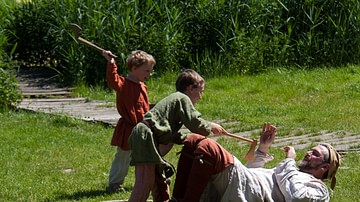
Childhood in the Viking Age
Childhood in the Viking Age (c. 750-1100) was largely undocumented as historical records primarily focus on adults, particularly men. Likewise, little is known about children's presence in the afterlife, as no runestones were raised in their...

Article
A Visual Who's Who of Greek Mythology
Achilles The hero of the Trojan War, leader of the Myrmidons, slayer of Hector and Greece's greatest warrior, who sadly came unstuck when Paris sent a flying arrow guided by Apollo, which caught him in his only weak spot, his heel. Adonis...

Article
The Family in Ancient Mesopotamia - Providing for Each Other Through Life and Past Death
Family in ancient Mesopotamia was considered the essential unit that provided social stability in the present, maintained traditions of the past, and ensured the continuance of traditions, customs, and stability for the future. The family...
