
Search
Remove Ads
Advertisement
Search Results

Definition
The Kingdom of Kush
Kush was a kingdom in northern Africa in the region corresponding to modern-day Sudan. The larger region around Kush (later referred to as Nubia) was inhabited c. 8,000 BCE but the Kingdom of Kush rose much later. The Kerma...

Definition
Ancient Egyptian Vizier
The vizier in ancient Egypt was the most powerful position after that of king. Known as the djat, tjat, or tjati in ancient Egyptian, a vizier was the equivalent of the modern-day prime minister of the nation who actually...
Definition
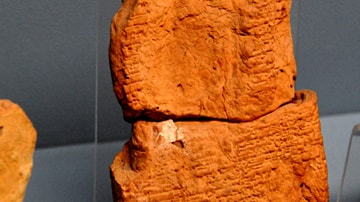
Code of Ur-Nammu - The Oldest Law Code in the World
The Code of Ur-Nammu (circa 2100-2050 BCE) is the oldest extant law code in the world. It was written by the Sumerian king Ur-Nammu (reign circa 2112-2094 BCE) or his son Shulgi of Ur (reign 2094 to...

Article
Chariots in Ancient Chinese Warfare
The chariot was used in Chinese warfare from around 1250 BCE but enjoyed its heyday between the 8th and 5th century BCE when various states were constantly battling for control of China. Employed as a status symbol...

Article
1204: The Sack of Constantinople
In 1204 CE the unthinkable happened and Constantinople, after nine centuries of withstanding all comers, was brutally sacked. Even more startling was the fact that the perpetrators were not any of the traditional...

Article
New Testament Text-Types
The books of the New Testament were written in the 1st century CE. As Christianity spread in the 2nd century CE, many copies were made, some by non-professionals. Early manuscripts are considered to be closer to the original...

Article
Visitor's Guide to Ancient Dion
Dion is located at the foot of Mount Olympus in the north of Greece, in what would have been ancient Macedon. It takes its name from the most important Macedonian sanctuary dedicated to Zeus ("Dios” meaning "of Zeus”...

Article
What Were the Consequences of WWII?
The consequences of the Second World War (1939-45) were many and varied. Nazi Germany, Fascist Italy, and military-dominated Japan were all defeated. Many occupied countries were liberated and regained their freedom...

Article
The Disappearance of Norse Greenland - A 600-Year-Old Mystery
From 985 until sometime in the 1400s, Greenland was the farthest, most isolated outpost of medieval Scandinavian society. For nearly 500 years, the Norse Greenlanders built churches, kept livestock...

Interview
Rubin Museum's Faith and Empire: Tibetan Buddhist Art
Faith and Empire: Art and Politics in Tibetan Buddhism, a new exhibition at the Rubin Museum of Art in New York, explores the dynamic historical intersection of politics, religion, and art as reflected...
