
Search
Remove Ads
Advertisement
Search Results

Article
Diodorus Siculus' Account of the Life of Semiramis
Semiramis is the semi-divine Warrior-Queen of Assyria, whose reign is most clearly documented by the Greek historian Diodorus Siculus (l. 90-30 BCE) in his great work Bibliotheca Historica ("Historical...

Article
The Magical Lullaby of Ancient Egypt
The Magical Lullaby (popularly known as Charm for the Protection of a Child) is an inscription from the 16th or 17th century BCE. The poem exemplifies the ancient Egyptian's personal religious and spiritual practices...

Interview
Interview: The Ancient Southwest
Pre-Columbian civilizations of the Southwestern United States and Northern Mexico include the Hohokam who occupied the US state of Arizona, the Anasazi or Ancestral Pueblo Peoples who resided in the Four Corners Region...

Article
Religious Responses to the Black Death
The Black Death of 1347-1352 CE is the most infamous plague outbreak of the medieval world, unprecedented and unequaled until the 1918-1919 CE flu pandemic in the modern age. The cause of the plague was unknown...

Interview
Interview: American School of Classical Studies at Athens
The American School of Classical Studies in Greece has been running its operations since the 19th century CE, with excavations across the country and an academic program that runs throughout the...

Article
Dynamics of the Neolithic Revolution
The Neolithic Revolution began between 10,000 and 12,000 years ago at several widely dispersed locations across the world, when our ancestors first began planting and raising crops. Agricultural communities sprang...
Article
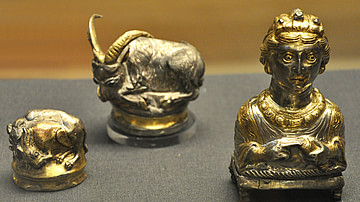
The Roman Hoxne Hoard
The Hoxne Hoard is the largest cache of late Roman gold found anywhere in the Roman Empire. Discovered by a metal detectorist in Suffolk, in the east of England in 1992 CE, the incredible collection contains 14,865 late-4th...

Image
Spearheads and Angons from Sutton Hoo
Spearheads and angons from the ship-burial mound 1 at Sutton Hoo, Suffolk, England, early 600s. The burial chamber at Sutton Hoo contained 6 spearheads of different shapes and 3 angons (barbed lances), all of...

Image
Doorway, Rock-Cut Tombs of Qizqapan
The square doorway at the façade of the rock-cut tombs of Ashkawt-i Qizqapan (Kurdish: The Cave of the Ravisher or the Cave of the Raped/Abducted Girl) leading to the central burial chamber (shown). The square...

Image
Pottery Bottle from Sutton Hoo
This bottle is the only piece of pottery from the Sutton Hoo ship-burial. It was made on a wheel, like Frankish pottery; early Anglo-Saxon pottery was typically handmade. Unglazed and therefore porous, it was only...
