
Search
Remove Ads
Advertisement
Search Results
Image
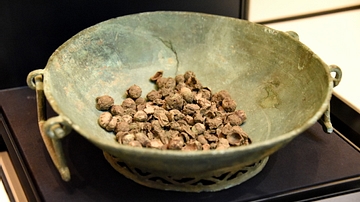
Anglo-Saxon Offering for the Dead
This large copper alloy bowl is filled with hazelnuts. It had been placed in a burial, perhaps as a symbolic offering or provision for the dead from the mourners who set out the grave. This vessel and its contents...

Image
Reconstructed Roman Grave Temple (Grutenhäuschen)
The Grutenhäuschen is a partially reconstructed Roman grave temple located in a vineyard slope near Igel on the Moselle in southwestern Germany. This funerary monument from the 3rd century CE was restored...

Image Gallery
Viking Ship Construction - A Step-by-step Visual Guide
In this gallery of 30 illustrations, we present the stages and techniques required to build the type of Viking ship Harald Hardrada, the future Norwegian king (reign 1046-1066), would likely have...

Image
Silver Bowl From Sutton Hoo
This shallow silver bowl is from a set of ten that were stacked upside-down inside the Suton Hoo burial chamber. They were made in the Eastern Mediterranean, possibly for religious use; their cross-shaped design may have...
Image
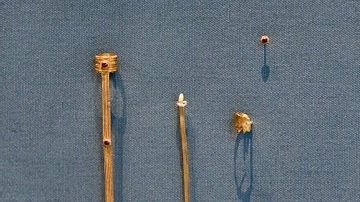
Gold Mounts from Sutton Hoo
These enigmatic mounts may have been emblems of office. Rivets and rivet-holes show that some were attached to other objects, perhaps bone or ivory rods that decayed in the ground. The most elaborate mount comprises a...

Image
Floor Chamber, Rock-Cut Tombs of Qizqapan
This is the right burial chamber at the rock-cut tombs of Ashkawt-i Qizqapan (Kurdish: The Cave of the Ravisher or the Cave of the Raped/Abducted Girl). This rectangular coffin was carved into the rocky floor...

Video
King Tutankhamun and the Discovery of His Tomb
King Tutankhamun (or King Tut as he is known) spent the early years of his life with the name Tutankhaten and was born in the eleventh year of the reign of his father Pharaoh Amenhotep IV, who is better...
Image
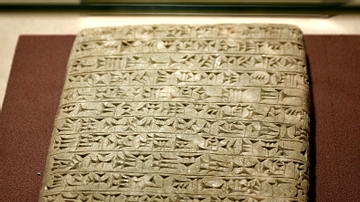
Stone Tablet of Queen Yaba
This stone tablet was found in a niche into the right-hand wall of the space leading to the burial chamber of Tomb II (one of the vaulted burial chambers of the so-called Queens' Tombs inside the North-West Palace at Nimrud...

Image
Map of the Scythian World, c. 700–300 BCE - Scythians, Saka, and Cultures of the Eurasian Steppe
Between c. 700 and 300 BCE, the Scythians and related Saka peoples inhabited vast regions of the Eurasian steppe, from the northern Black Sea to Central Asia and...

Image
The Sutton Hoo Great Gold Buckle
The Great Gold Buckle from the Sutton Hoo Ship-burial Mound 1, England, UK. Early Anglo-Saxon, early 7th century. The British Museum, London. Its form with curved sides and 3 domed bosses resembles Frankish buckles...
