
Search
Did you mean: Asuka Period?
Remove Ads
Advertisement
Search Results

Image
Vase of Utu-Hegal of Uruk
This is only known bronze/copper alloy vessel inscribed with the name of Utu-Hegal, King of Uruk. Utu-Hegal was considered a hero, who drove the hated Gutian invaders out of Southern Mesopotmia. The inscribed cuneiform...

Definition
Three Kingdoms Period in Korea
The Three Kingdoms Period of ancient Korea (57 BCE – 668 CE) is so-called because it was dominated by the three kingdoms of Baekje (Paekche), Goguryeo (Koguryo), and Silla. There was also, though, a fourth entity...

Image
Stele of Lion-Hunt from Uruk
Stele of a lion-hunt from Uruk, the oldest narrative Mesopotamian sculpture (in relief) and the first documented evidence of lion-hunting in Mesopotamia. It depicts two men hunting lions using a spear and arrows. One...

Image
Mosaic Fragment from Uruk
This piece of wall decoration (mosaic) was part of one of the walls of the white temple at Warka (Uruk) city. Stone cones are inlaid on a gypsum background. Uruk period, 3500-2800 BCE, Mesopotamia, Iraq. (The Sulaimaniya...

Definition
The Ancient City
In the study of the ancient world a City is generally defined as a large populated urban center of commerce and administration with a system of laws and, usually, regulated means of sanitation. This is only one definition, however...

Image
Facade of Inanna's Temple at Uruk
Part of the facade of the temple of Inanna at Uruk. There are standing male and female deities in alternate niches. Each figure holds a vessel in his/her hands and pours life-giving water onto the earth. The cuneiform...

Image
Bust of a Priest from Uruk
Grey alabaster statue of a male priest, found inside a pottery vessel in the ancient city of Uruk by a German archaeological team from the German Oriental Society in 1929-1930. Probably, it was buried after it got broken...

Image
Facade of Inanna Temple from Uruk at the Iraq Museum
This is part of the facade of the temple of goddess Inanna at Uruk (modern-day Warka, southern Iraq) and is made of bricks. There are standing male and female deities in alternating niches. Both hold...
Image
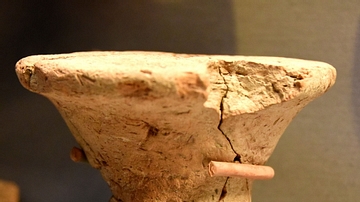
Dedicatory Cone of Sin-Kashid king of Uruk
This clay nail is inscribed with details of the wealth of Sin-Kashid, king of Uruk in Babylon. Excavated by Sir William Loftus at Uruk (Warka), Southern Mesopotamia, modern-say Iraq. Circa 1900 BCE. (The British...

Definition
Later Three Kingdoms Period
The Later Three Kingdoms period (889-935 CE) of ancient Korea saw a partial revival of the old three kingdoms which had dominated the peninsula from the 1st century BCE to the 7th century CE. After the Unified Silla kingdom...
