
Search
Did you mean: Asuka Period?
Remove Ads
Advertisement
Search Results
Image
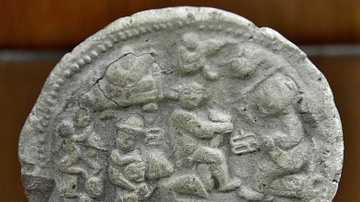
Pottery Plaque from the Hellenistic Period
This round pottery plaque depicts various human daily activities. In the middle, a man and a woman are having sex, and on the left, a standing woman holds a young child on her shoulders. Hellenistic Period...

Image
Knight from the Hellenistic Period
This is a fragment of a terracotta plaque, which depicts a knight riding a horse. He holds a sword with his right arm. From Mesopotamia, Iraq. The Hellenistic period, 334-139 BCE. (The Sulaymaniayh Museum, Iraq)

Definition
Akkad and the Akkadian Empire - The First Multinational Empire in the World
The city of Akkad was the seat of the Akkadian Empire (2350/2334-2154 BCE), the first multinational political entity in the world, founded by Sargon the Great, who unified Mesopotamia...
Definition
Godin Tepe
Godin Tepe is, today, an archaeological site in the Kangavar valley of Luristan, in western central Iran. The name means "hill of Godin" though what the settlement was called originally is unknown. The site was first discovered in...

Definition
Near East - A Modern Term for an Ancient Land
The 'Near East' is a modern-age term for the region formerly known as the 'Middle East,' comprising Armenia, Cyprus, Egypt, Iraq, Iran, Israel, Jordan, Lebanon, Palestine, Syria, and part of Turkey, corresponding...

Image
Map of the Assyria in the Middle Assyrian Period - Campaigns and Rival Powers in the Late Bronze Age
The Middle Assyrian period (c. 1365–1000 BCE) emerged from the shifting balance of power in the Late Bronze Age Near East. After earlier subordination to Mitanni...

Image
Samurai Armour, Sengoku Period
Samurai facemask and armour from the Sengoku period (Warring States Period), 1467-1568 CE. (Ann and Gabriel Barbier-Mueller Museum, Dallas, USA)

Image
Predynastic Period Vessel from Egypt
Terracotta vessel from the Predynastic Period in Egypt, c. 4500-3100 BCE. From the late Predynastic Period onward, the Egyptians used painted, incised, and polished pottery in life and as burial accessories for...

Image
Jomon Period Dogu
This is a headless dogu. Earthenware figures (dogu) were important in the Jomon period and as many as 1000 have been found at some sites. Some seem to represent imaginary animals but most are human in shape. Are they females...

Image
Japanese Beads from the Kofun Period
These beads come from Japan and date from the Kofun period (250-538 CE) in Japanese history. In the Kofun Period beads of various shapes and materials were worn as fashion accessories, used in rituals, and buried...
