
Search
Remove Ads
Advertisement
Search Results

Image
Tokugawa Ieyasu
Portrait of Tokugawa Ieyasu (1543-1616) by Kanō Tan'yū, Edo period.
Osaka Castle, Main Tower.

Image
Tokugawa Iemitsu
Tokugawa Iemitsu (1604-1651).
Okayama Prefectural Museum.
Image
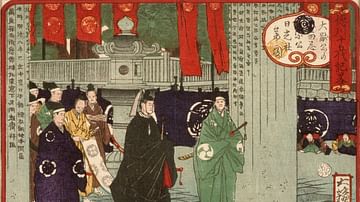
Tokugawa Tsunayoshi Visiting Nikkō Shrine
Tokugawa Tsunayoshi Visiting Nikkō Shrine, woodblook print by Tsukioka Yoshitoshi, 1875.
Los Angeles County Museum of Art.
Image
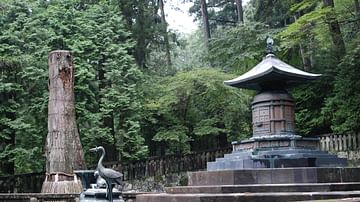
Tokugawa Ieyasu Mausoleum
Tokugawa Ieyasu Mausoleum, Nikko, Japan.

Definition
Kamakura
Kamakura is a coastal town located on Sagami Bay on Honshu Island, Japan, which was the capital of the Kamakura Shogunate from 1192 to 1333 CE. Provided with excellent natural defensive features, it was fortified and made the base of the...

Image
Model of Edo Castle during the Tokugawa Period
Scale model of the Honmaru and Ninomaru Palaces of Edo Castle, as they would have appeared during the late Tokugawa Shogunate. (Edo-Tokyo Museum, Japan)

Definition
Azuchi-Momoyama Period
The Azuchi-Momoyama Period (Azuchi-Momoyama Jidai, aka Shokuho Period, 1568/73 - 1600 CE) was a brief but significant period of medieval Japan's history which saw the country unified after centuries of a weak central government and petty...

Image
Tokugawa Yoshinobu
Tokugawa Yoshinobu, the last shogun of Japan in Osaka, 1867.
Tojo Museum of History, Matsudo.

Definition
Chikamatsu Monzaemon
Chikamatsu Monzaemon (1653-1725) was a Japanese playwright who wrote for both the puppet theatre and kabuki. He is regarded as Japan’s greatest dramatist. Apart from their aesthetic appeal, his plays are of value because they provide an insight...

Article
The Mongol Invasions of Japan, 1274 & 1281 CE
The Mongol invasions of Japan took place in 1274 and 1281 CE when Kublai Khan (r. 1260-1294 CE) sent two huge fleets from Korea and China. In both cases, the Japanese, and especially the samurai warriors, vigorously defended their shores...
