
Search
Remove Ads
Advertisement
Search Results

Definition
Ancient Egyptian Religion
Egyptian religion was a combination of beliefs and practices which, in the modern day, would include Egyptian mythology, science, medicine, psychiatry, magic, spiritualism, herbology, as well as the modern understanding...
Definition
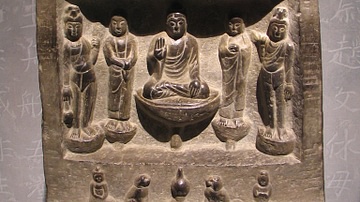
Balhae
The Balhae (Parhae) kingdom in Manchuria (698-926 CE) was an important regional power which interacted both peacefully and otherwise with its neighbours the Unified Silla Kingdom of Korea and Tang China. The latter was a strong cultural...

Definition
Caesarion
Ptolemy XV Caesar “Theos Philopator Philometor” (“the Father-loving Mother-loving God”) (c. 47-30 BCE), better known by his unofficial nickname Caesarion or “Little Caesar” in Greek, was the oldest son of Cleopatra VII (69-30 BCE...

Image
Tang Dynasty Provinces c. 742 CE
The provinces of the Tang Dynasty c. 742 CE. The Tang Dynasty (618-907 CE) is regularly cited as the greatest imperial dynasty in ancient Chinese history. It was a golden age of reform and cultural advancement, which...

Article
Ming Taxation & the Silver Economy
The rulers of China's Ming dynasty (1368-1644) acquired an insatiable desire for silver in the 16th century, largely to pay for huge prestige projects like building the Forbidden City in Beijing and repairing the...

Definition
Taejo of Goryeo
Taejo (r. 918-943 CE), previously known as Wang Geon or Wang Kon, was the founder and first king of the Goryeo (Koryo) kingdom which unified and ruled ancient Korea from 918 CE to 1392 CE. Wang Geon was given the posthumous title...

Definition
Cleopatra VII - The Last Great Pharaoh of Ancient Egypt
Cleopatra VII (69-30 BCE, reign 51-30 BCE) was the last ruler of Egypt before it was annexed as a province of Rome. Arguably the most famous Egyptian queen, Cleopatra was ethnically Greek as a member...

Definition
Cleopatra Selene II
Cleopatra Selene II (40 - c. 5 BCE) was a member of the Ptolemaic Dynasty who became the queen of Mauretania upon her marriage to King Juba II of Numidia (48 BCE - 23 CE). Though more obscure than her famous mother, Cleopatra...

Definition
Taifa
Taifas ("factions" or "camps") were small independent Muslim kingdoms and principalities that emerged after the fall of hegemonic Muslim caliphates in al-Andalus – the Muslim-controlled part of the Iberian peninsula – during the High...
Definition
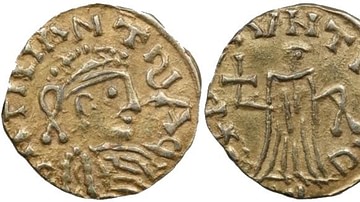
Guntram I of Orléans
Guntram I (also given as Gontrand, Gunthram, or Gunthchramn) was a Merovingian king who ruled over the Frankish kingdom of Orléans, later referred to as Burgundy, from 561 to 592. He often took on the role of mediator in the...
