
Search
Remove Ads
Advertisement
Search Results

Definition
First Anglo-Sikh War
The First Anglo-Sikh War (1845-6) was a short and bloody conflict won by the British East India Company (EIC) against the Sikh Empire. The EIC was keen to expand into northern India, but the Sikh army was a well-trained, well-equipped...
Definition
Lombards
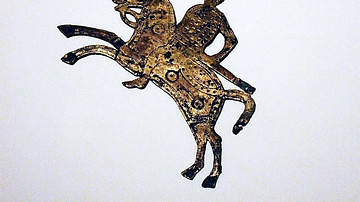
The Lombards were a Germanic tribe that originated in Scandinavia and migrated to the region of Pannonia (roughly modern-day Hungary). Their migration is considered part of "The Wandering of the Nations" or "The Great Migration", which...
Definition
Commagene
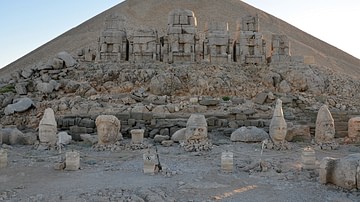
The Kingdom of Commagene (163 BCE - 72 CE) was a Hellenistic political entity, heavily influenced by Armenian and ancient Persian culture and traditions, established in southwestern Anatolia (modern-day Turkey) by Ptolemaeus of Commagene...
Definition
Alboin
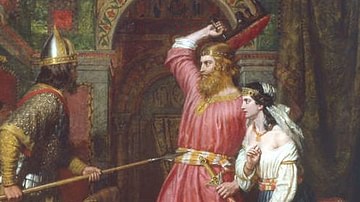
Alboin (r. 560-572 CE) was a king of the Lombards who led his people into Italy and founded the Kingdom of the Lombards which lasted from 568-774 CE. His father was Audoin, King of the Lombards, and his mother Queen Rodelinda. He was...

Definition
Islam
Islam is an Abrahamic-monotheistic religion based upon the teachings of Prophet Muhammad ibn Abdullah (l. 570-632 CE, after whose name Muslims traditionally add “peace be upon him” or, in writing, PBUH). Alongside Christianity and Judaism...

Definition
Maria Theresa - The Great Habsburg Empress
Maria Theresa (1717-1780) was the ruler of the Habsburg Monarchy, a sprawling empire that included Austria, Hungary, Bohemia, and other territories spread out across Italy, the Netherlands, and Central Europe...

Definition
Spanish Main
The Spanish Main refers, in its widest sense, to the Spanish Empire in the Americas from Florida in the north to the northern coast of Brazil in the south, including the Caribbean. The term was initially more limited and referred...

Definition
Byzantine Architecture
The architecture of the Byzantine Empire (4th - 15th century CE) continued its early Roman traditions but architects also added new structures to their already formidable repertoire, notably improved fortification walls and...

Definition
Leo III
Leo III was emperor of the Byzantine Empire from 717 to 741 CE. He founded the Isaurian dynasty which ruled until 802 CE. The emperor was a talented administrator, and he revamped the empire's political apparatus and legal code. Leo's...

Definition
Justinian I
Justinian I reigned as emperor of the Byzantine Empire from 527 to 565 CE. Born around 482 CE in Tauresium, a village in Illyria, his uncle Emperor Justin I was an imperial bodyguard who reached the throne on the death of Anastasius...
