
Search
Did you mean: Thutmose III?
Search Results
Image
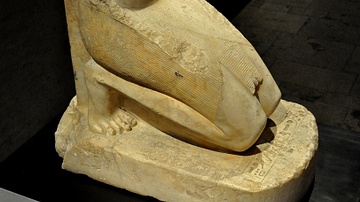
Statue of Thutmose III
Only the lower half of this calcite kneeling figure of the Egyptian pharaoh Thutmose III has survived. From Karnak, modern-day Egypt. New Kingdom, 18th Dynasty, circa 1450 BCE. (State Museum of Egyptian Art, Munich, Germany).

Definition
Ancient Egyptian Warfare
The Narmer Palette, an ancient Egyptian ceremonial engraving, depicts the great king Narmer (c. 3150 BCE) conquering his enemies with the support and approval of his gods. This piece, dating from c. 3200-3000 BCE, was initially thought to...
Image
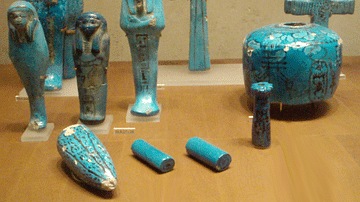
Objects from the Tomb of Thutmose IV
Objects from the tomb of Thutmose IV, 14th century BCE, including amulets in the form of the ankh, the symbol of life or everlasting life. Two large amulets in the shape of an ankh were found among shabti figures and other funerary objects...

Video
Thutmose, Bust of Nefertiti, c. 1340 BCE
More free lessons at: http://www.khanacademy.org/video?v=cZuYdIRAIAs
Thutmose, Model Bust of Queen Nefertiti, New Kingdom, 18th dynasty, c. 1340 BCE, limestone and plaster (Egyptian Museum and Papyrus Collection/Neues Museum, Berlin)

Collection
Pharaoh of Egypt
Early ancient Egypt was ruled by kings, and only from the New Kingdom period (c. 1570 - c. 1069 BCE) did the title of 'pharaoh' appear. Considered a god on earth and the supreme ruler of his people, a pharaoh was one of the most powerful...

Definition
The Kingdom of Kush
Kush was a kingdom in northern Africa in the region corresponding to modern-day Sudan. The larger region around Kush (later referred to as Nubia) was inhabited c. 8,000 BCE but the Kingdom of Kush rose much later. The Kerma Culture, so named...

Definition
The Great Sphinx of Giza
The Great Sphinx of Giza is the most instantly recognizable statue associated with ancient Egypt and among the most famous in the world. The sculpture, of a recumbent lion with the head of an Egyptian king, was carved out of limestone on...

Article
Interrelations of Kerma and Pharaonic Egypt
The vacillating nature of Ancient Egypt's associations with the Kingdom of Kerma may be described as one of expansion and contraction; a virtual tug-of-war between rival cultures. Structural changes in Egypt's administration led to alternating...

Video
Hatshepsut: the Forgotten Woman who was a King of Egypt
Hatshepsut, whose name means Foremost of Noble Women or She is First Among Noble Women is the forgotten woman who was a King of Ancient Egypt. She began as regent for her stepson Thutmose III and presented herself as a woman, but later she...
Definition
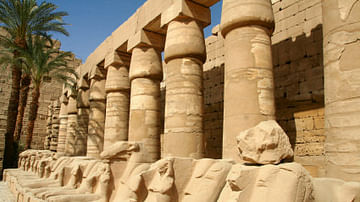
Karnak
Karnak is the modern-day name for the ancient site of the Temple of Amun at Thebes, Egypt. The Egyptians called the site Nesut-Towi, "Throne of the Two Lands", Ipet-Iset, "The Finest of Seats" as well as Ipt-Swt, "Selected Spot" also given...
