
Search
Did you mean: Thutmose III?
Search Results

Image
Queen Nefertiti
A bust of Egyptian queen Nefertiti ("The Beautiful One Has Come", c. 1370 to c. 1336 BCE), the wife of the pharaoh Akhenaten of the 18th Dynasty of Egypt. By the sculptor Thutmose and rediscovered in 1912.
Neues Museum, Berlin.

Image
Worker's Tomb, Deir el-Medina
A worker's tomb at the site of Deir el-Medina, a village for artists and masons who built the royal tombs in the nearby Valley of the Kings, Egypt. The village was in continuous use from the time of Thutmose I (1520-1492 BCE) until the collapse...

Image
Deir el-Medina
The site of Deir el-Medina, a worker's village for artists and masons who built the royal tombs in the nearby Valley of the Kings, Egypt. The village was in continuous use from the time of Thutmose I (1520-1492 BCE) until the collapse of...
Image
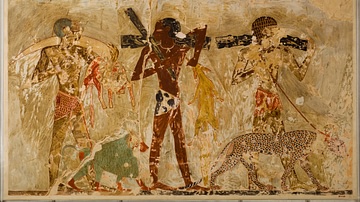
Tribute Bearers, Tomb of Rekhmire
Facsimile of a painting of foreigners bearing tribute in the form of timber, ebony, ivory and animals. On the far right, a man carrying ebony leads a cheetah on a leash. Behind him walks a man with timber and an animal (possibly an aardvark...

Image
Vizier Rekhmire Receiving Offerings
A depiction from the tomb of the vizier Rekhmire showing him and his mother receiving offerings. Rekhmire served under the pharaohs Thutmose III (1458-1425 BCE) and his son Amenhotep II (1425-1400 BCE). (Metropolitan Museum of Art, New York...
Image
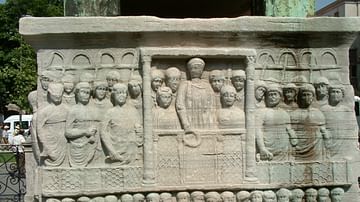
Roman Emperor at the Hippodrome
A relief scene showing a Roman emperor (probably Theodosius I) with his entourage in the royal box at the Hippodrome of Constantinople. From the 4th century CE base of the column of the obelisk of Thutmose III which once stood in centre of...

Image
Boat of Queen Mutemwia
This sculpture represents a sacred boat on a sledge. It included a seated figure of Queen Mutemwia, wife of Thutmose IV. Only her legs and right hand remained intact, but part of the head is also in the British Museum. Mutemwia clasps a looped...
Image
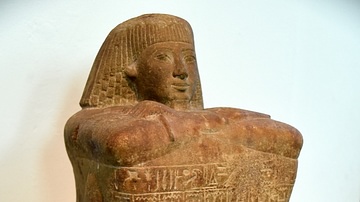
Block Statue of Teti
Teti, who held many official and priestly titles, sits on a mat. He wears a priest's leopard skin and sandals. The tail of the leopard lies beside his right foot. His right hand clasps a lotus flower, a symbol of rejuvenation. The hieroglyphic...

Image
Egyptian sphinx from Diocletian's Palace
Diocletian's Palace was decorated with numerous granite sphinxes originating from the site of Egyptian Pharaoh Thutmose III. Only three have survived the centuries. This one is still located on the Peristyle of Diocletian's Palace.

Image
Egyptian Door Jamb
Limestone fragment of a door jamb from the temple of Seth (built by the Egyptian pharaoh Thutmose III) at Ombos (Naqada), Egypt, 18th Dynasty, 1543-1292 BCE. The Petrie Museum of Egyptian Archaeology, London (With thanks to The Petrie Museum...
