
Search
Remove Ads
Advertisement
Search Results

Definition
Vesta
Vesta was the goddess of the hearth, the home, and domestic life in the Roman religion (idenitified with the Greek goddess Hestia). She was the first-born of the titans Kronos and Rhea and, like the others, was swallowed by her father...

Definition
Delphi
Delphi was an important ancient Greek religious sanctuary sacred to the god Apollo. Located on Mt. Parnassus near the Gulf of Corinth, it was home to the famous oracle of Apollo which gave cryptic predictions and guidance to both city-states...

Definition
Asclepius
Asclepius was the ancient Greek god of medicine, and he was also credited with powers of prophecy. The god had several sanctuaries across Greece; the most famous was at Epidaurus which became an important centre of healing in both...

Definition
Mavia
Mavia (r. c. 375-c. 425 CE) was a warrior-queen of the semi-nomadic Tanukhid Arab tribe of Syria and Jordan who led a successful insurrection against Rome in 378 CE. She is also known as Maowiva, Mu`awiya, Mauia, Mania, and Mawiyya. Her...

Definition
Menelaus of Alexandria
Menelaus of Alexandria was a Greek astronomer, scientist, and mathematician who lived around 100 CE. Menelaus made a significant and lasting contribution to the fields of astronomy, geometry, and trigonometry. His major work...
Definition
Isis
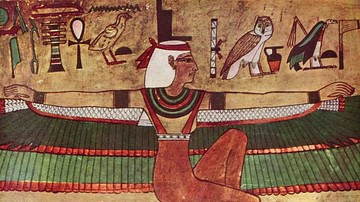
Isis is an ancient Egyptian goddess who became the most popular and enduring of all the Egyptian deities. Her name comes from the Egyptian Eset, ("the seat") which referred to her stability and also the throne of Egypt as she was considered...

Article
Constantine’s Conversion to Christianity
Constantine I (Flavius Valerius Constantinus) was Roman emperor from 306-337 CE and is known to history as Constantine the Great for his conversion to Christianity in 312 CE and his subsequent Christianization...

Article
The Ideal of Christendom in Antiquity
The ideal of Christendom is a historical and political vision where society and government are unified under the Christian faith. According to this vision, power on Earth is divided between the church through...

Article
Passing of Philosophy to Religion: The Death of Hypatia
The death of the philosopher Hypatia of Alexandria (l. c. 370-415) has long been considered the "passage of philosophy to religion", exemplifying the transition from the pagan values of antiquity...

Article
Byzantine-Armenian Relations
The relationship between the Byzantine Empire and ancient Armenia was a constant and varied one with an equal mix of wars, occupations, treaties of friendship, mutual military aid, and cultural exchange. Regarded as...
