
Search
Did you mean: Armenian Mythology?
Remove Ads
Advertisement
Search Results

Article
The Instructions of Shuruppag - Ancient Philosophical Wisdom
The Instructions of Shuruppag (circa 2500/2000 BCE) is the most famous work of the genre of Sumerian wisdom literature whose purpose was to encourage proper behavior in conformity with cultural...

Definition
Nanshe - The Selfless Sumerian Goddess of Social Justice
Nanshe (also known as Nanse, Nazi) is the Sumerian goddess of social justice and divination, whose popularity eventually transcended her original boundaries of southern Mesopotamia toward all points...

Article
Hymn to Nisaba - A Praise Song for the Sumerian Goddess of Writing
The Hymn to Nisaba (circa 3rd millennium BCE) is a poem praising Nisaba, the Sumerian goddess of writing and accounts who also served as scribe of the gods. The poem is officially dedicated...

Video
Social Orders and Creation Stories: Crash Course World Mythology #5
In which Mike Rugnetta sits you down for a little talk about myth as a way to construct or reinforce social orders. Specifically, we’re going to look today at stories from around the world...

Definition
Library of Ashurbanipal
The Library of Ashurbanipal (7th century BCE) is the oldest known systematically organized library in the world, established in Nineveh by the Neo-Assyrian king Ashurbanipal (r. 668-627 BCE) to preserve the history and culture...

Article
Festivals in Ancient Mesopotamia - Courting the Goodwill of the Gods
Festivals in ancient Mesopotamia honored the patron deity of a city-state or the primary god of the city that controlled a region or empire. The earliest, the Akitu festival, was first...

Video
The Greeks and Romans - Pantheons Part 3: Crash Course World Mythology #9
This week, we continue our look at various Pantheons, and Mike digs deep into the gods of the ancient Greeks. We're talking Zeus, Hera, Poseidon, Hades, Artemis, Hephaestos, Ares...

Definition
Freyja
Freyja (Old Norse for 'Lady', 'Woman', or 'Mistress') is the best-known and most important goddess in Norse mythology. Beautiful and many-functioned, she features heavily as a fertility goddess stemming from her place in the Vanir family...

Definition
Hestia
Hestia was the Greek virgin goddess of the hearth, home, and hospitality. In Greek mythology, she is the eldest daughter of Cronus and Rhea. In her role as a protector of the family and political community, sacrifices and offerings were...
Article
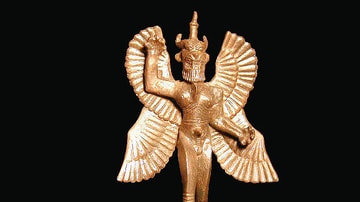
Twelve Menacing & Protective Mythological Figures
The term mythology comes from the Greek words mythos (“story of the people”) and logos (“word”) and so is defined as the spoken (later written) story of a culture. Modern scholars have divided myths...
