
Search
Remove Ads
Advertisement
Search Results

Article
A Brief History of Egyptian Art
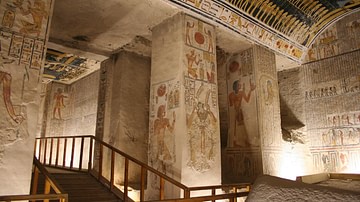
Art is an essential aspect of any civilization. Once the basic human needs have been taken care of such as food, shelter, some form of community law, and a religious belief, cultures begin producing artwork, and often...
Article
Tomb Robbing in Ancient Egypt
The tombs of the great kings and nobles of Egypt were built to safeguard the corpse and possessions of the deceased for eternity and yet, while many have endured for thousands of years, their contents often disappeared...

Article
Tobacco & Colonial American Economy
The most important cash crop in Colonial America was tobacco, first cultivated by the English at their Jamestown Colony of Virginia in 1610 CE by the merchant John Rolfe (l. 1585-1622 CE). Tobacco grew in the wild...
Definition
Cuicuilco
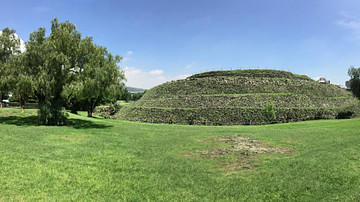
Cuicuilco is an ancient settlement site in central Mexico, now located in southern Mexico City. Prominent in the late pre-Classic period, around 500 BCE, it is noted for its large circular temple mound, one of the earliest monumental...
Definition
Tlaloc
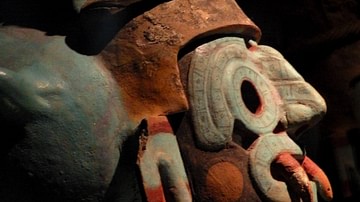
Tláloc (pron. Tla-loc) is one of the most important and formidable gods in the Aztec pantheon. He was considered the god of rain, water, lightning and agriculture. Tlaloc was seen as both a benevolent god providing life-giving rain but...

Definition
Middle Kingdom of Egypt - Ancient Egypt's Classical Age
The Middle Kingdom (2040-1782 BCE) is considered ancient Egypt's Classical Age, during which it produced some of its greatest works of art and literature. Scholars remain divided on which dynasties...

Definition
Tenochtitlan
Tenochtitlan (also spelled Tenochtitlán), located on an island near the western shore of Lake Texcoco in central Mexico, was the capital city and religious centre of the Aztec civilization. The traditional founding date of the city...

Definition
Labyrinth
The word labyrinth comes from the Greek labyrinthos and describes any maze-like structure with a single path through it which differentiates it from an actual maze which may have multiple paths intricately linked. Etymologically the...

Definition
Medieval Folklore
Medieval folklore is a body of work, originally transmitted orally, which was composed between the 5th and 15th centuries in Europe. Although folktales are a common attribute of every civilization, and such stories were being...

Definition
Vardhamana
Vardhamana (l. c. 599-527 BCE), better known as Mahavira (“Great Hero”) is the sage credited with founding of the nontheistic religion of Jainism, a belief system established in the 6th and 5th centuries BCE in India, which provided...
