
Search
Did you mean: Satyr?
Remove Ads
Advertisement
Search Results

Definition
Croesus
Croesus (r. 560-546 BCE) was the King of Lydia, a region in western Asia Minor (modern-day Turkey) and was so wealthy that the expression "as rich as Croesus" originates in reference to him. Best known for his wealth, he is also famous...

Definition
Carthaginian Coinage
The coinage of Carthage was first minted from the 5th century BCE. Initially adopting the drachma, the Carthaginians later minted silver shekel coins. Designs were instantly recognisable, as intended, and included famous figures...
Image
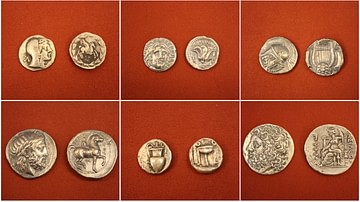
Ancient Greek Silver coins
Top row (L to R): - Silver drachm from Corcyra (Corfu), 229-48 BCE. O: Head of Dione. R: Pegasus. - Silver didrachm from Rhodes, Caria, 304-166 BCE. O: Head of Helios. R: Rose. - Silver stater from Calymna, Caria...
Image
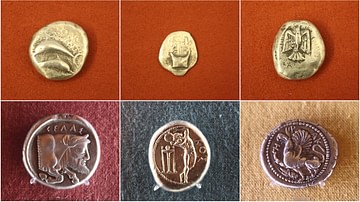
Ancient Greek Coins
Top row (L to R): Thera (c. 500 BCE) - Silver stater, two dolphins. Delos (6th century BCE) - Silver drachm, lyre. Siphnos (540-500 BCE) - Silver stater, eagle. (Alpha Bank Numismatics Museum, Kerkyra, Corfu) Bottom...

Definition
Battle of Wilson's Creek - The "Bull Run of the West"
The Battle of Wilson's Creek (also known as the Battle of Oak Hills, 10 August 1861) was the second major battle of the American Civil War and the first major battle of the Western theater of the war...
Image
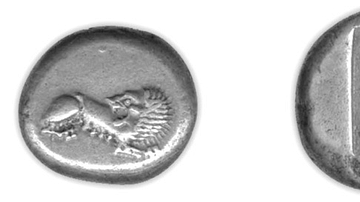
Colchian Type I Silver Didrachm
Silver. Weight: 10 gr., 10,1 gr., 11,3 gr., 11,4 gr. – Persian stater; 7,9 gr., 8,1 gr., 8,6 gr., 8,6 gr., 9,4 gr. (?) – Attic didrachm.
d= 17/20-20/21 mm.
Obverse: Lying hermaphrodite lion to the right/left...

Article
The Invention of the First Coinage in Ancient Lydia
Money may take many forms, from the digital code of cryptocurrency to the woodpecker scalps favoured in early California. People have also used cattle, cacao beans, cowrie shells, chewing gum, grain...

Article
The Economy of Ptolemaic Egypt
Ptolemaic Egypt rapidly established itself as an economic powerhouse of the ancient world at the end of the 4th century BCE. The wealth of Egypt was owed in large part to the unrivalled fertility of the Nile, which...

Image
Greek Coins
Top row (L to R): Cos (300-190 BCE) Silver tetradrachm, crab. Syracuse (c. 400 BCE) - Silver decadrachm, head of Arethousa with dolphins. Macedon (306-283 BCE) - Silver tetradrachm, Poseidon with trident. Bottom row (L to...
Image
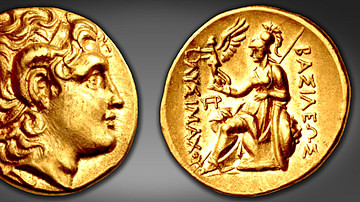
Coin of Lysimachus
Gold stater minted under the authority of King Lysimachus of Thrace (r. 305-281 BCE), show the deified portrait of Alexander the Great, wearing the royal fillet (diadema) with the ram's horn of Ammon on the obverse; the reverse...
