
Search
Did you mean: Satyr?
Remove Ads
Advertisement
Search Results
Image
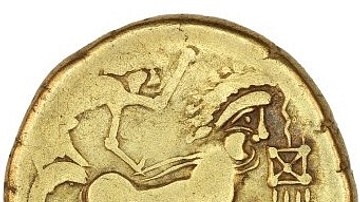
Gallic Coin with Charioteer
The reverse of a 2nd Century - 1st Century BCE gold stater minted in Gaul. This side depicts a man riding a chariot which is being pulled by a horse with a stylized human face. From the British Museum in London.

Image
Roman Lead Weight Decorated with Cornucopia
This lead weight was decorated with a terminal figure, cornucopia (horn of plenty), and an ear of barley. The weight is dated to the 4th year of a Hellenistic king. It is a standard mna (half stater) of a...

Image
Achaemenid Lion Weight
One side of this heavy weight is inscribed in Aramaic with "correct according to the stater of silver". This probably refers to the use of a weight standard based on the silver coins known as staters. This object weighs just...
Image
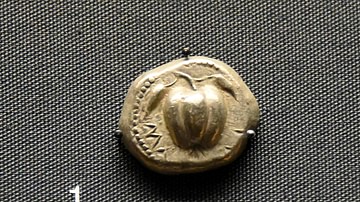
Coin from Melos
Silver stater coin, from Melos, Greece, c. 450 BCE.
Some Greek cities used images for their names, so "readers" did not have to be literate. In Melos, an apple (mēlon) was used.
The British Museum, London.
Image
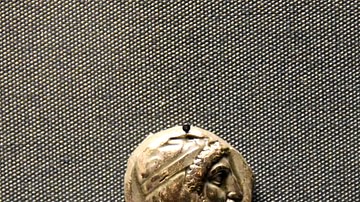
Coin of a Persian Satrap
In the Persian Empire, some regional governors (satraps) were authorized to issue coins for military purposes. They combine Persian and Greek imagery, showing a satrap's head and a local reverse image. These are some of...
Image
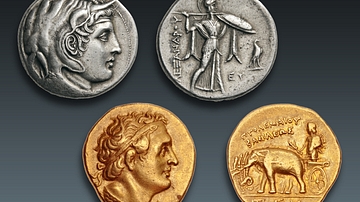
Elephant Symbolism on the Coins of Ptolemy I
Two coins issued by Ptolemy I: 1) A portrait of the deified Alexander the Great wearing an elephant scalp on his head, with a ram’s horn over his temple, and an aegis (sacred fleece) over his shoulder...
Image
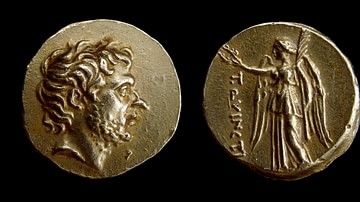
Gold Coin of Titus Quinctius Flamininus
Gold stater in the name of Titus Quinctius Flamininus, probably issued in the wake of the victory at the Battle of Cynoscephalae (197 BCE), minted in Greece, 196 BCE.
The British Museum, London.
Image
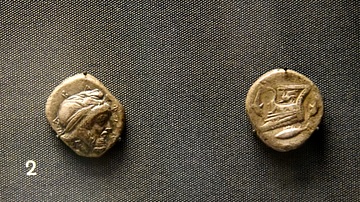
Coins Depicting a Persian Satrap
In the Persian Empire, some regional governors (satraps) were authorized to issue coins for military purposes. They combine Persian and Greek imagery, showing a strap's head and a local reverse image. These are some...

Image
Coin of Amastris
Silver stater issued by Amastris (r. c. 300 - 285 BCE) in Paphlagonia. Neither the youthful portrait nor the enthroned goddess may be a direct portrait of Amastris, but in both Greek and Persian terms they express her claim to...

Image
Coin of Commius
Iron Age plated gold stater, struck for Commius, found in the Southern Region of Britain, dating to the period c. 50-25 BCE. Obverse: Wreath design with two hidden faces. Reverse: Horse right, wheel below. The British Museum...
