
Search
Remove Ads
Advertisement
Search Results

Definition
Despotate of Epirus
The Despotate of Epirus was one of the successor states of the Byzantine Empire when it disintegrated following the Fourth Crusade's capture of Constantinople in 1204 CE. It was originally the most successful of those successor...

Article
Enheduanna - Poet, Priestess, Empire Builder - Redefining the Gods for the People
Enheduanna (circa 2300 BCE) is the world's first author and was the daughter (either literally or figuratively) of the great empire-builder Sargon of Akkad (reign 2334-2279 BCE...

Article
The Roman Empire in West Africa
At its fullest extent, the Roman Empire stretched from around modern-day Aswan, Egypt at its southernmost point to Great Britain in the north but the influence of the Roman Empire went far beyond even the borders of...

Article
Sassanian Kings List & Commentary
The Sassanian Empire (224-651) was the greatest expression of Persian culture in the ancient world. It was consciously modeled on the earlier Achaemenid Empire (c. 550-330 BCE) which established Persian supremacy...

Definition
Walter Raleigh
Sir Walter Raleigh (c. 1552-1618 CE) was an English courtier, soldier, mariner, explorer, and historian. A one-time favourite of his queen, Elizabeth I of England (r. 1558-1603 CE), Raleigh organised three expeditions to form a...

Article
Ten Notorious French Pirates
Piracy has involved many nationalities over the centuries, but one of the prominent groups in the medieval and early modern periods was the French pirates, who terrorised the Atlantic, the Caribbean, and the Indian Ocean...
Image
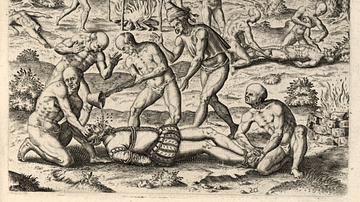
Spanish Conquistadores Being Tortured
A 16th-century print by Theodor de Bry showing indigenous peoples gaining revenge on Spanish Conquistadores in the Americas by pouring molten gold down their throats. (From Grand Voyages Accounts to the Americas...

Article
Royal Women in the Mughal Empire
It was not only the Mughal emperors that left an indelible mark in the history of the Indian subcontinent but also the queens and princesses. The latter's contributions to art, architecture, literature, cuisine, refinement...

Article
Women in the Byzantine Empire
Women in the Byzantine Empire (4th to 15th century CE) were, amongst the upper classes, largely expected to supervise the family home and raise children while those who had to work for a living did so in most of the...

Article
Society in the Byzantine Empire
The society in the Byzantine Empire (4th-15th century CE) was dominated by the imperial family and the male aristocracy but there were opportunities for social advancement thanks to wars, population movements, imperial...
