
Search
Did you mean: Amarna?
Remove Ads
Advertisement
Search Results

Article
Disarming Aphrodite: Rediscovering the Venus de Milo
The so-called Vénus de Milo is perhaps one of the most iconic works of Western art of any period. The statue of the goddess was found on the Aegean island of Milos, to which she owes her name, on the eve of the Greek War of Independence (1821-1830...
Article
Laocoön: The Suffering of a Trojan Priest & Its Afterlife
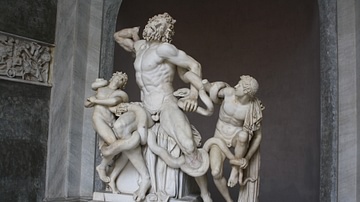
The sculpture group of Laocoön and His Sons, on display in the Vatican since its rediscovery in 1506, depicts the suffering of the Trojan prince and priest Laocoön (brother of Anchises) and his young sons Antiphantes and Thymbraeus and is...

Article
The Battle of Philippi 42 BCE
The Battle of Philippi in 42 BCE was an all-Roman affair fought between the young Octavian, chosen heir of Julius Caesar, and the mercurial Mark Antony, widely regarded as the greatest living Roman general on the one side against Brutus and...

Article
Hadrian's Travels
No other Roman emperor travelled as much as Hadrian (r. 117-138 CE). The 'restless' emperor spent more time travelling than in Rome, devoting half of his 21-year reign to the inspection of the provinces. His travels provided him with the...
Article
Melito of Sardis and his Apology for Christianity
Melito of Sardis (d. c. 180 CE) was a bishop in the city of Sardis (near modern-day Sart, Turkey) who was regarded as one of the greatest Christian thinkers, writers, and apologists of his time. In the modern age, he is best known for his...

Article
Paul's Journeys and the Mediterranean Trade
Mediterranean trade increased exponentially at the turn of the first millennium. During Rome's zenith, goods of all sorts began to move in all directions. As a common traveler aboard merchant ships, Paul traveled within such a milieu. Tracing...
Article
Eusebius on Christianity
Eusebius Pamphili (aka Eusebius of Caesarea, 260-340 CE) was a Christian historian, exegete, and polemicist. He became the bishop of Caesarea Maritima in 314 CE and served as court bishop during the reign of Constantine I (r. 306-337 CE...

Article
Herodotus on Lydia
Herodotus’ narrative on Lydia takes up almost one half of Book I of his Histories and the section dealing with King Croesus is among the best-known and often anthologized. The last section, in which he discusses Lydian women as prostitutes...
Article
Famous Grammarians & Poets of the Byzantine Empire
In the wake of the downfall of the Western Roman Empire and the intellectual collapse of Athens, Byzantine scholars engaged in preserving the Classical Greek language and its literature. Thus they became the guardians of a vanished culture...
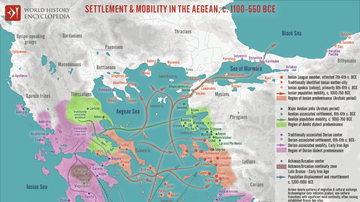
Image
Map of Settlement & Mobility in the Aegean, c. 1100-550 BCE - Migration, Memory, and the Making of the Greek World
The period following the collapse of the Mycenaean palatial system (c. 1200–1100 BCE) saw profound demographic and cultural reorganization across the Aegean. During the so-called Greek “Dark Age” (c. 1100–800 BCE), communities fragmented...
