
Search
Remove Ads
Advertisement
Search Results

Definition
English Reformation
The English Reformation began with Henry VIII of England (r. 1509-1547 CE) and continued in stages over the rest of the 16th century CE. The process witnessed the break away from the Catholic Church headed by the Pope in Rome...

Definition
Amun
Amun (also Amon, Ammon, Amen, Amun-Ra) is the ancient Egyptian god of the sun and air. He is one of the most important gods of ancient Egypt who rose to prominence at Thebes at the beginning of the period of the New Kingdom (c. 1570-1069...

Definition
Richard Wagner
Richard Wagner (1813-1883) was a German composer of Romantic music most famous for his epic operas like The Ring, Tannhäuser, and Tristan and Isolde. Wagner was concerned throughout his career with the theme of redemption through...

Definition
Siren - The Woman-Bird Creatures of Greek Mythology
Sirens were creatures from Greek mythology that enticed sailors to their destruction with their irresistibly beautiful singing. The most famous appearance of sirens in literature is in Homer's Odyssey...

Definition
John Quincy Adams - Champion of Liberty
John Quincy Adams (1767-1848) was an American statesman and diplomat who served as the sixth president of the United States (1825-1829). The son of a former president, Adams had a long and distinguished political...

Definition
John Smith
Captain John Smith (l. 1580-1631 CE) was an English explorer, soldier, author, and early governor of the Jamestown Colony of Virginia between 1607-1609 CE. Smith had served as a mercenary in his younger years and was well-versed in...

Definition
Zephyrus
Zephyrus was the god of the west wind and the messenger of spring in Greek mythology. He was known as one of the four Anemoi, or wind gods, each of whom represented a cardinal direction and, except for Eurus, a season. Zephyrus was...
Definition
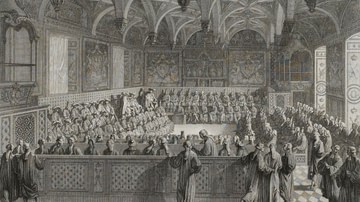
Revolt of the Parlements
The Revolt of the Parlements of 1787-1788, was the climax of a power struggle between the royal authority of King Louis XVI of France (r. 1774-1792) and the Parlement of Paris, the most powerful of France's thirteen parlements...

Definition
Paul Gauguin
Eugène Henri Paul Gauguin (1848-1903) was a French neo-impressionist painter whose vivid paintings with their flat, bold colours and use of mystical and ambiguous symbols revolutionised art. Never quite gaining success in his own...

Definition
Shimabara Rebellion
The Shimabara Rebellion was a peasant uprising that occurred from 17 December 1637 to 15 April 1638 in Japan's southern island of Kyushu. Economic desperation, famine, and religious persecution led the peasants of the Shimabara...
