
Search
Remove Ads
Advertisement

 This answer was generated by
Search Results

Definition
Robert Boyle
Robert Boyle (1627-1691) was an Anglo-Irish chemist, physicist, and experimental philosopher. Boyle was a prolific author, made significant experiments with air pumps, and presented the first litmus test. A founding member of the...

Article
Rosalind Franklin - Equal Co-Discoverer of DNA?
The structure of deoxyribonucleic acid (DNA) was discovered in 1953 by two molecular biologists, James Dewey Watson (1928-2025) and Francis Harry Compton Crick (1916-2004). Watson and Crick were awarded...

Definition
Robert Hooke
Robert Hooke (1635-1703) was an English scientist, architect, and natural philosopher who became a key figure in the Scientific Revolution. Hooke conducted his scientific experiments outside the auspices of universities, and he was...
Definition
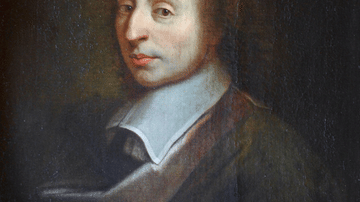
Blaise Pascal
Blaise Pascal (1623-1662) was a French scientist, mathematician, and philosopher whose work influenced both the Scientific Revolution and later European thought. Pascal is known for his practical achievements in science, such as...

Definition
Edmond Halley
Edmond Halley (1656-1742) was an English astronomer, mathematician, and cartographer. Halley's Comet is named after him since he accurately predicted its return in 1758. One of the early globetrotting scientists, Halley led several...

Collection
12 Great Scientists of the Scientific Revolution
In this collection, we gather together some of the greatest minds of the Scientific Revolution (1500-1700) when European science made great leaps forward, particularly in the fields of astronomy, microscopy...

Definition
Galileo Galilei
Galileo Galilei (1564-1642) was an Italian mathematician, physicist, astronomer, and natural philosopher. He created a superior telescope with which he made new observations of the night sky, notably that the surface of the Moon...

Definition
Isaac Newton
Isaac Newton (1642-1727) was an English mathematician and physicist widely regarded as the single most important figure in the Scientific Revolution for his three laws of motion and universal law of gravity. Newton's laws became...

Definition
Ancient Greek Science
Ancient Greek science is a modern term for the application of systematic inquiry into the individual, the world, and the universe, which began in Ionia in the 6th century BCE with Thales of Miletus (l. c. 585 BCE) and continued...

Definition
Christiaan Huygens
Christiaan Huygens (1629-1695) was a Dutch mathematician, physicist, and astronomer. A leading figure of the Scientific Revolution, Huygens combined research into mathematical-based theories, such as the movement of light waves...
