
Search
Remove Ads
Advertisement
Search Results

Definition
Despotate of the Morea
The Despotate of the Morea was a semi-autonomous appanage of the later Byzantine Empire. The Byzantines retook part of the Peloponnese in Southern Greece in 1262 CE, but the Morea was only officially governed by semi-autonomous despots of...
Definition
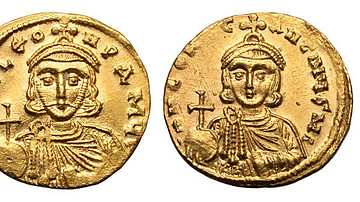
Constantine V
Constantine V, also known as Constantine the Dung-named by his enemies, was emperor of the Byzantine empire from 741 to 775 CE. He enjoyed military successes in the Middle East and Balkans but his reign is chiefly remembered for his systematic...

Definition
Chrocus
Chrocus (Crocus) was a king of the Alemanni who invaded Roman Gaul c. 256 CE until he was defeated by the Roman legions at Arles and then executed. Conversely, he was a king of the Alemanni who served Rome and supported Constantine the Great...
Image
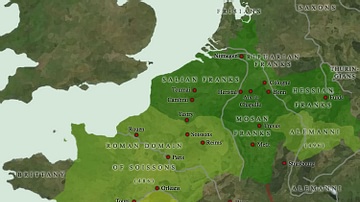
Map of the Frankish Kingdoms AD 481-511
With the accession of Clovis, son of Childeric I of the Salian Franks, the Germanic occupiers of north-eastern Gaul had found a king who would change their fortunes out of all recognition. Rather than follow his father's policy of allying...

Article
The Ideology of the Holy Roman Empire
"The Holy Roman Empire was in no way holy, nor Roman, nor an empire," wrote Voltaire, and this interpretation still dominates the popular imagination, so the Holy Roman Empire is treated as a bad joke, a pale parody of the glory of Rome...

Image
Map of the Rise and Expansion of the Merovingians, c. 639
The Merovingians (c. 481–751 CE) were a Frankish dynasty that rose to prominence in the late 5th century CE, unifying diverse Frankish tribes across regions that now include France, western Germany, the Low Countries, Switzerland, and parts...

Definition
Constantine I
Constantine I, aka Constantine the Great, was Roman emperor from 306 to 337 CE. Realizing that the Roman Empire was too large for one man to adequately rule, Emperor Diocletian (284-305 CE) split the empire into two, creating a tetrachy or...

Definition
Migration Age
The Migration Period, also called the Barbarian Invasions or German: Völkerwanderung (wandering of the peoples), was a period of human migration that occurred roughly between 300 to 700 CE in Europe, marking the transition from Late Antiquity...

Definition
The Goths
The Goths were a Germanic tribe who are frequently referenced for their part in the fall of the Roman Empire and their subsequent rise to power in the region of northern Europe, initially in Italy. Prior to their contact with Rome they must...

Definition
Western Roman Empire
The Western Roman Empire is the modern-day term for the western half of the Roman Empire after it was divided in two by the emperor Diocletian (r. 284-305 CE) in c. 285/286 CE. The Romans themselves did not use this term. At its height (c...
