
Search
Remove Ads
Advertisement
Search Results
Image
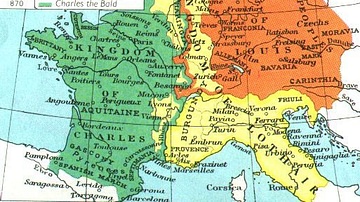
Division of the Carolingian Empire in 843 & 870 CE
Map of the Carolingian empire following its division in the 9th Century CE. The Treaty of Verdun in 843 CE partitioned the Kingdom of the Franks into West Francia (green), East Francia (orange), and Middle Francia (yellow) and allocated them...

Image
Audomar of Thérouanne & Dagobert I
The installation and investiture of Bishop Saint Audomar of Thérouanne (early 7th century - c. 670) in 637 by Dagobert I (r. 629-639), King of the Franks. From the illuminated manuscript of the Life of Saint Omer; 11th century, Chapter of...

Image
Conquests of Clovis I
A map illustrating the conquests of Clovis I (466-511/513 CE), King of the Franks.

Image
East Roman Empire, 6th century CE
East Roman Empire, 6th century CE, showing the territories of the Avars, Goths, Franks, Lombards, Saxons, Thuringians, Slavs.
Image
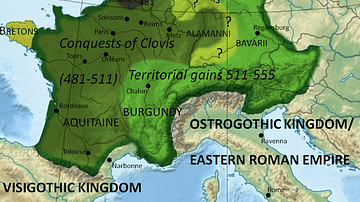
Frankish territory in 555
Territory occupied by the Franks in 555 after the conquest of northern Italy.
Image
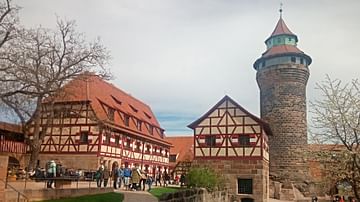
Nuremberg Castle
The Imperial Castle is Nuremberg's landmark, a symbol for the power and importance of the Holy Roman Empire. Nuremberg (Nürnberg), first documented as a royal estate in 1050, was an important base for the domestic power politics during the...

Image
Map of the Holy Roman Empire under Otto the Great c. 972
This map illustrates the emergence of the Holy Roman Empire in the mid-10th century, following the final division of the Eastern and Western Frankish realms in the late 9th century. Under Otto I (r. as German king 936–973; crowned Holy Roman...

Image
The Development of Slavonic Literacy & the Cyrillic Alphabet - The Cultural Transformation of Eastern Europe, c. 863-900
The missions of Saints Cyril and Methodius transformed the religious and cultural development of Central and Eastern Europe during the 9th century. Sent by Michael III (reign 842-867) from the Eastern Roman Empire (“Byzantine Empire”) to...

Image
Frankish Bird-Shaped Brooch
Frankish Bird-Shaped Brooch, second half of 6th century CE. This brooch would have been worn by a woman and is characteristic of Frankish jewelry and fine workmanship.
Image
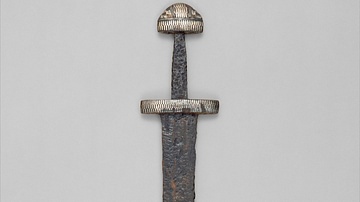
Viking Pattern-Welded Sword
A 10th Century CE steel sword, likely made in Scandinavia. The high quality of the pattern-welded steel blade, and beautiful decoration on the hilt, indicates that it was owned by a high status warrior. Steel blade, decorated with copper...
