
Search
Did you mean: Roman Mills?
Remove Ads
Advertisement
Search Results

Article
Views of the Afterlife in Roman Tombstone Inscriptions
Ancient views of the afterlife are reflected in literature, tomb inscriptions, and grave goods. Then, as now, a belief in another stage of existence after death was a shared belief by all ancient...

Definition
Antonine Plague
The Antonine Plague, sometimes referred to as the Plague of Galen, erupted in 165 CE, at the height of Roman power throughout the Mediterranean world during the reign of the last of the Five Good Emperors, Marcus Aurelius Antoninus...

Video
The Ancient Roman Emperor Hadrian
Hadrian (l. 78-138 CE) was emperor of Rome (r. 117-138 CE) and is recognized as the third of the Five Good Emperors (Nerva, Trajan, Hadrian, Antoninus Pius, and Marcus Aurelius) who ruled justly. His reign marked...
Article
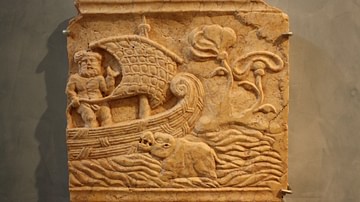
Roman Shipbuilding & Navigation
Unlike today, where shipbuilding is based on science and where ships are built using computers and sophisticated tools, shipbuilding in ancient Rome was more of an art relying on rules of thumb, inherited techniques...

Article
Practicing Magic in Greco-Roman World - Alexander of Abunoteichos & the Greek Magic Papyri
Magic was ever-present in the wider Greco-Roman world. Spells and herbs, spirits and gods, curses and blessings, prophecies and oracles, they were all the domain of the...

Collection
Ancient Roman Warfare
With a huge reserve of resources in men and equipment and a culture geared for warfare, the Romans were relentless in expanding their borders and putting their neighbours to the sword. The Roman army, with its well-trained...

Definition
Antinous
Antinous (l. c. 110-130 CE) was a youth of Bithynia who became the beloved of the Roman emperor Hadrian (l. 76-138 CE, r. 117-138 CE) from around the age of 13 until his death at nearly 20. His year of birth is unknown as are any details...

Article
Ancient Cyprus: A Travel Guide
Lying at the crossroads of the eastern Mediterranean, the island of Cyprus has long been a meeting point for many of the world's great civilizations. Situated where Europe, Asia and Africa meet, its location shaped...

Definition
Huns
The Huns were a nomadic tribe prominent in the 4th and 5th century whose origin is unknown but, most likely, they came from "somewhere between the eastern edge of the Altai Mountains and the Caspian Sea, roughly modern Kazakhstan" (Kelly...

Article
Roman Household Spirits: Manes, Panes and Lares
To the ancient Romans, everything was imbued with a divine spirit (numen, plural: numina) which gave it life. Even supposedly inanimate objects like rocks and trees possessed a numen, a belief which no...
